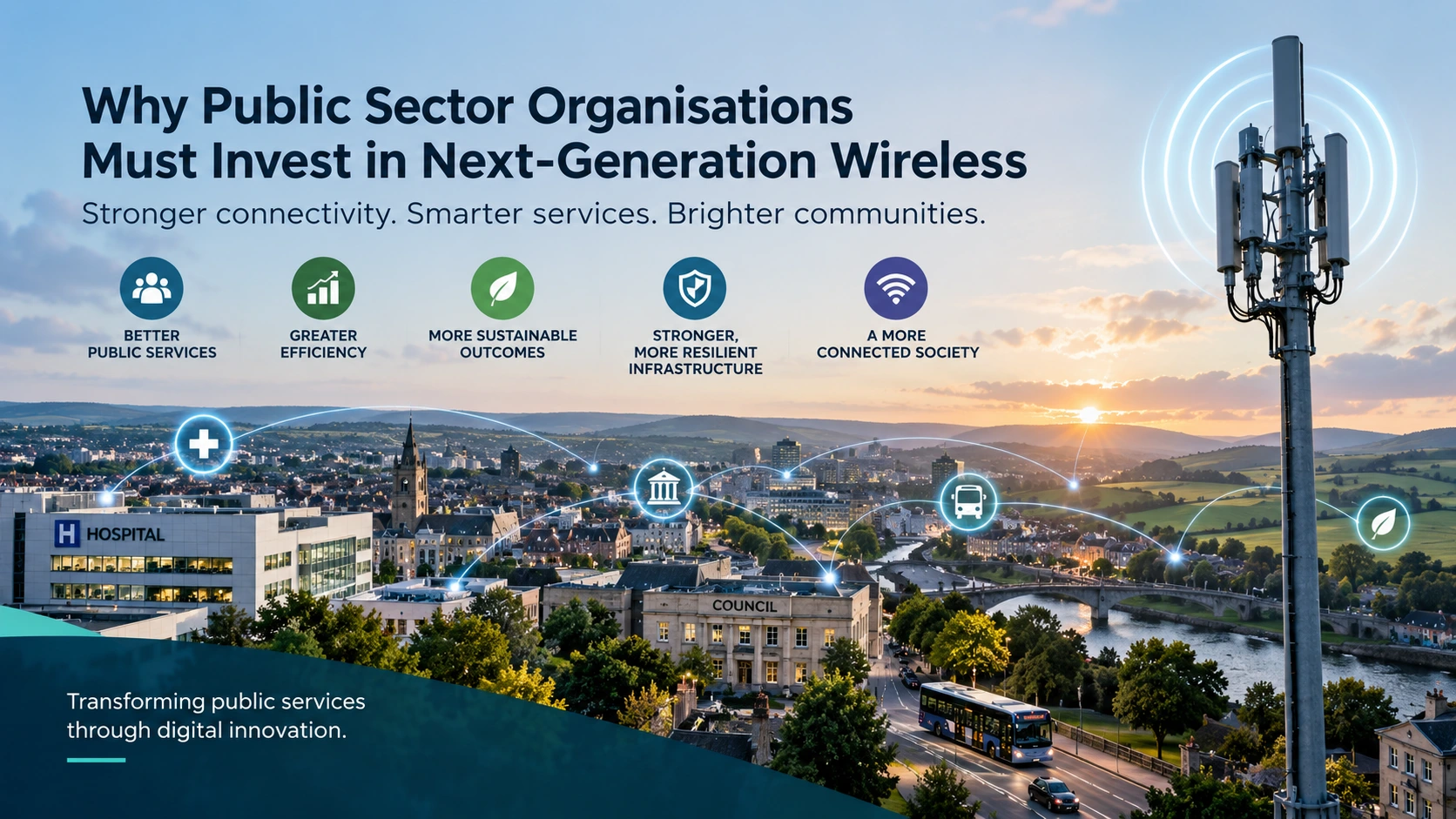
Public services are becoming increasingly digital, connected and data-driven. From smart infrastructure and connected healthcare to mobile workforces and digitally enabled communities, public sector organisations depend on reliable connectivity to deliver services effectively.
Yet the demands being placed on wireless networks are changing rapidly.
Traditional connectivity models are not always designed for the scale, flexibility, resilience and responsiveness that modern public services require. As organisations look to support new technologies and improve outcomes for citizens, investment in next-generation wireless is becoming a strategic consideration rather than simply an IT upgrade.
For public sector leaders, the question is no longer whether connectivity matters. It is how to build a wireless infrastructure that can support the services, technologies and communities of the future.
What is next-generation wireless?
Next-generation wireless encompasses a range of evolving wireless technologies and approaches, including advanced 4G and 5G networks, private wireless networks, Wi-Fi advancements and other solutions designed to provide more capable and flexible connectivity.
The right solution will depend on the organisation, location, use case and existing infrastructure.
For a public sector organisation, however, the value goes beyond faster download speeds. Modern wireless networks can provide improved capacity, lower latency, greater flexibility and support for large numbers of connected devices.
This creates opportunities to rethink how public services are delivered.
1. Public services increasingly depend on reliable connectivity
Digital transformation is now embedded across the public sector.
Local authorities are using connected technologies to manage assets, support transport, improve public spaces and make better use of data. Healthcare organisations are increasingly dependent on digital systems and connected devices. Government teams need secure and reliable access to information while working across offices, communities and operational environments.
When connectivity is unreliable, these services can become less effective.
Next-generation wireless can help organisations build connectivity into their wider digital infrastructure strategy, providing additional options where traditional fixed networks may not be practical, economical or sufficiently flexible.
The objective should not simply be to introduce new technology. It should be to create a more resilient foundation for better public services.
2. It can enable new approaches to public service delivery
One of the greatest opportunities presented by next-generation wireless is the ability to connect people, places, devices and systems in new ways.
Consider a local authority managing a large estate of buildings and public assets. Connected sensors could provide information about energy consumption, environmental conditions, occupancy or asset performance. Data from these systems could help teams identify problems earlier and make better-informed decisions.
Similarly, connected infrastructure can support applications across transport, public safety, environmental monitoring and economic development.
Wireless connectivity can be particularly valuable where devices need to operate across larger areas or where installing new physical infrastructure would be difficult or expensive.
The important point is that the network becomes an enabler for wider transformation.
3. 5G and private wireless can create more flexible connectivity
5G has attracted considerable attention because of its potential to provide high-performance wireless connectivity. For public sector organisations, one of the more interesting opportunities is the development of private wireless networks for specific locations or operational environments.
A private network can potentially provide an organisation with greater control over connectivity, performance and access than relying solely on conventional public networks.
Potential applications include:
- Connected public infrastructure
- Large operational sites
- Healthcare environments
- Transport and logistics
- Emergency and critical services
- Industrial or community settings
- Connected sensors and Internet of Things (IoT) applications
However, private wireless is not automatically the right answer for every organisation. A robust business case should consider the use case, coverage requirements, security, existing infrastructure, operational capability and long-term costs before investment is made.
4. Connectivity can support smarter and more sustainable services
Public sector organisations are under continuing pressure to improve services while making responsible use of limited budgets and reducing environmental impact.
Better connectivity can contribute to both objectives.
Connected systems can provide organisations with better information about how buildings, infrastructure and services are being used. This can support more efficient resource management and help identify opportunities to reduce unnecessary energy consumption, travel or maintenance.
For example, data from connected assets can enable a shift from reactive maintenance towards more proactive approaches. Instead of waiting for an asset to fail, organisations may be able to identify emerging issues and intervene earlier.
The result can be better decision-making, improved service continuity and potentially lower whole-life costs.
This is particularly important when considering wireless investment as part of a broader digital infrastructure strategy rather than as an isolated technology project.
5. It can help bridge connectivity gaps
Not every community or public service environment has the same connectivity requirements or access to infrastructure.
Rural and hard-to-reach areas can present particular challenges. Extending traditional fixed infrastructure can sometimes be complex, costly or slow, depending on local circumstances.
Wireless technologies can provide additional options for extending connectivity and supporting digitally enabled services.
For public sector organisations, this can contribute to wider ambitions around digital inclusion, economic development and access to services.
Connectivity is increasingly linked to participation in modern society. Supporting better access therefore has implications beyond technology—it can affect how residents access information, education, healthcare, employment and public services.
6. Public sector investment requires a strong business case
Despite the opportunities, investing in next-generation wireless should not be driven by technology alone.
Public sector organisations must demonstrate value for money, manage risk and ensure that investment supports clearly defined outcomes.
That means asking fundamental questions before selecting a technology or supplier:
- What problem are we trying to solve?
- Who will benefit from the investment?
- What outcomes should the programme deliver?
- What infrastructure already exists?
- Which wireless approach is most appropriate?
- What will the whole-life cost be?
- How will the solution be secured, operated and maintained?
- How will it integrate with existing systems?
A clear strategy and robust business case provide the foundation for making these decisions with confidence.
7. Procurement and implementation matter just as much as technology
Selecting the right technology is only one part of a successful wireless programme.
Public sector organisations also need to consider requirements definition, commercial models, procurement, contracts, implementation, governance and ongoing operations.
Poorly defined requirements can result in solutions that are technically impressive but difficult to operate or unable to deliver the intended benefits.
A pragmatic approach is therefore essential.
Organisations should define what success looks like before going to market and ensure that procurement arrangements reflect both current requirements and future needs. Contracts should provide appropriate flexibility while protecting public value and managing operational and technology risks.
This is where specialist experience can make a significant difference.
8. The right investment starts with strategy, not technology
There is no single wireless solution that will work for every public sector organisation.
For some, enhancing existing Wi-Fi or mobile connectivity may be the most appropriate approach. For others, 5G, private wireless, IoT connectivity or a combination of technologies may unlock significant opportunities.
The starting point should therefore be the organisation’s objectives.
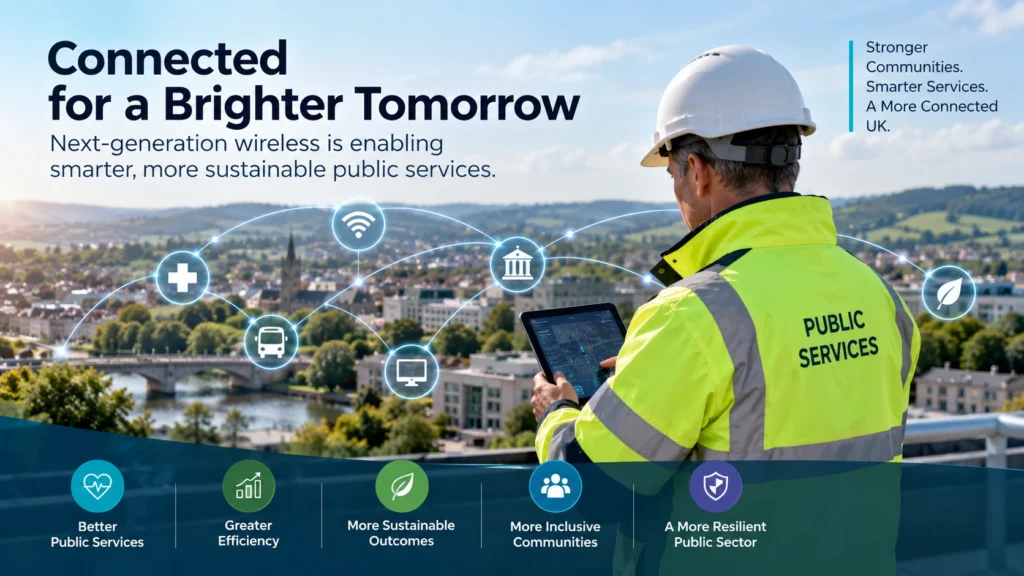
A sensible approach can include:
1. Assess the current position
Understand existing networks, infrastructure, coverage, contracts, capabilities and constraints.
2. Identify priority use cases
Focus on the services and operational challenges where better wireless connectivity could deliver meaningful benefits.
3. Build the business case
Assess costs, benefits, risks, funding opportunities and alternative approaches.
4. Define clear requirements
Translate strategic objectives into practical technical, commercial and operational requirements.
5. Procure the right solution
Select a delivery and commercial model that provides value, resilience and flexibility.
6. Plan for the full lifecycle
Consider implementation, support, maintenance, skills, governance and future technology evolution from the outset.
This lifecycle approach helps ensure that investment delivers sustainable value rather than becoming another standalone technology project.
A connected future for public services
The future of public services will be increasingly connected.
Wireless technologies will play an important role in enabling organisations to connect infrastructure, devices, employees and communities—and in creating the digital foundations for new models of service delivery.
But successful transformation is not about adopting the newest technology for its own sake.
It is about understanding the problem, developing a clear strategy, building a compelling business case and delivering infrastructure that works in the real world.
For public sector organisations, next-generation wireless should therefore be considered as part of a wider conversation about digital infrastructure, service transformation, resilience, sustainability and value for money.
At Spirit Public Sector, we work exclusively with public sector organisations to help turn complex digital infrastructure and technology challenges into practical, deliverable solutions. Our approach combines sector knowledge, strategic insight and delivery experience—from developing strategies and business cases through to defining requirements, procurement, implementation and operations.
As public services become more connected, the organisations that invest thoughtfully in the right infrastructure today will be better positioned to deliver smarter, more sustainable outcomes tomorrow.
The next generation of public services needs a next generation of connectivity.