A strong business case is more than a document that supports a funding request. For public sector organisations, it should provide a clear, evidence-based route from a strategic ambition to a deliverable programme that creates measurable value for citizens and communities.
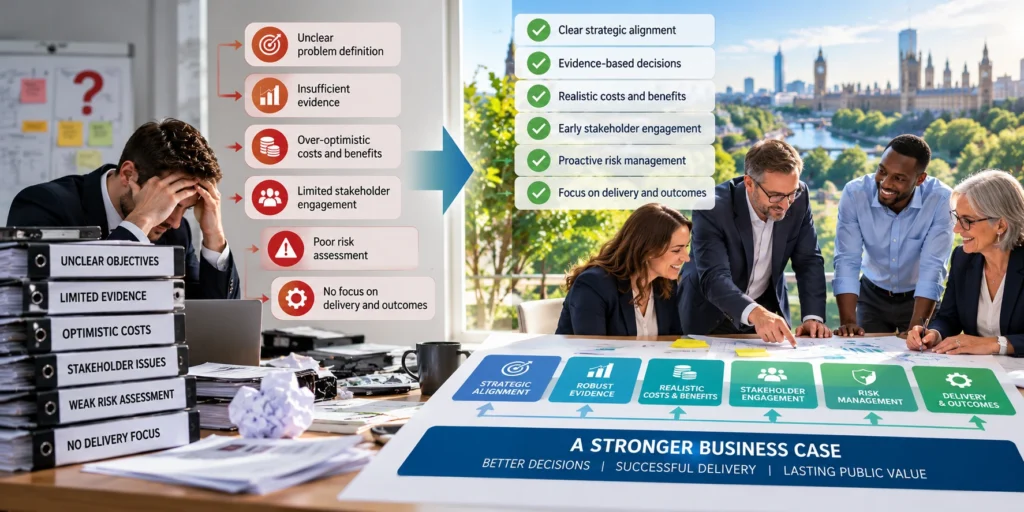
Yet even well-intentioned business cases can fail to achieve their purpose. Sometimes the strategy is unclear. Sometimes the evidence is insufficient. In other cases, financial assumptions are too optimistic, stakeholders have not been properly engaged, or the case is developed in isolation from how the proposed change will actually be delivered.
For public sector organisations managing limited budgets, increasing demand and complex transformation programmes, these weaknesses can create significant risks.
So what causes strategic business cases to fail, and what can organisations do differently?
What makes a strategic business case important?
A strategic business case helps an organisation establish why a proposed investment or programme is needed, what it is intended to achieve and how it could be delivered.
For public sector organisations, this means looking beyond the immediate project. A robust case should connect the proposed investment with wider organisational priorities, service needs, financial constraints and outcomes for citizens.
This is particularly important for digital infrastructure, technology and transformation programmes, where the benefits may extend across multiple services or organisations.
A good business case can help decision-makers answer fundamental questions:
- What problem are we trying to solve?
- Why does it need to be addressed now?
- What outcomes do we want to achieve?
- What options are available?
- What will each option cost?
- What benefits and risks are associated with each option?
- How will the preferred approach be implemented?
- How will we measure whether it has delivered the expected results?
When these questions are addressed clearly, the business case becomes a practical foundation for decision-making rather than simply an approval document.
Why strategic business cases fail
1. The strategic problem is not clearly defined
One of the most common weaknesses is starting with a preferred solution rather than the underlying problem.
For example, an organisation may decide that it needs a new technology platform, improved connectivity or a major IT transformation. But if the business case does not clearly establish the service problem or strategic opportunity behind the investment, it can become difficult to demonstrate why the proposed solution is necessary.
A stronger approach starts with the outcomes.
What is not working today? Who is affected? What is the impact? What could improve if the problem were addressed?
Defining the problem clearly creates a stronger foundation for everything that follows.
2. The case is disconnected from organisational strategy
A business case should not exist in isolation from the organisation’s wider objectives.
If a proposal cannot demonstrate how it contributes to strategic priorities, decision-makers may struggle to understand its importance or assess it against competing investments.
For public sector organisations, this could mean demonstrating how a programme supports priorities such as improving public services, increasing efficiency, strengthening digital infrastructure, improving accessibility, supporting economic development or delivering better outcomes for communities.
The strategic connection should be explicit rather than assumed.
3. Options are not properly considered
A business case becomes less credible when it appears that the preferred solution was decided before the analysis began.
Decision-makers need to understand the alternatives. This does not necessarily mean evaluating every conceivable option, but it does mean demonstrating that realistic approaches have been identified and assessed.
Depending on the project, alternatives could include:
- Maintaining the current approach
- Improving existing systems or processes
- Working collaboratively with other organisations
- Procuring a new solution
- Taking a phased approach
- Developing a shared or regional solution
- Delaying the investment and assessing the consequences
Considering options helps demonstrate that the recommended approach has been reached through structured analysis rather than assumption.
4. Costs and benefits are overly optimistic
Financial credibility is fundamental to a successful business case.
Costs that are understated or benefits that are overstated can undermine confidence in the entire proposal. This is particularly important for complex technology and infrastructure programmes, where implementation costs, dependencies and ongoing operational requirements can be difficult to estimate.
A robust case should distinguish between known costs, assumptions and areas of uncertainty.
Benefits should also be specific enough to measure. Rather than simply stating that a programme will “improve efficiency”, organisations should establish what improvement is expected, for whom, over what timeframe and how it will be measured.
This creates a stronger basis for benefits realisation once implementation begins.
5. Risks are treated as an afterthought
Every significant public sector investment carries risks.
These could relate to procurement, funding, technology, implementation, adoption, security, interoperability, resources, dependencies or changes in the external environment.
Ignoring risks does not make them disappear. In fact, an unrealistic presentation of risk can reduce confidence in an otherwise strong proposal.
A better business case identifies the principal risks, considers their potential impact and establishes appropriate mitigation measures. It should also recognise where risks cannot be eliminated entirely and explain how they will be managed.
6. Stakeholders are brought in too late
A business case developed entirely by a small project team can miss important operational realities.
Senior leaders, finance teams, service managers, technical specialists, procurement professionals, frontline staff and other stakeholders may all have different perspectives on the problem and the proposed solution.
Early engagement can uncover constraints and opportunities before they become expensive problems.
It can also create greater ownership. People are more likely to support a programme when they understand the rationale behind it and have had an opportunity to contribute to its development.
For public sector organisations, where successful transformation often depends on collaboration across teams and organisations, this is particularly important.
7. The business case stops at approval
Securing approval is not the end of the process.
A business case should provide a foundation for implementation, procurement, programme management and benefits realisation. If the assumptions made during development are forgotten once funding is approved, the organisation can lose the connection between the original investment case and actual delivery.
The strongest approach treats the business case as a living reference point.
As a programme progresses, organisations can revisit costs, risks, assumptions and expected benefits to determine whether the investment remains on track.
How to build a business case that succeeds
Start with outcomes, not technology
Technology may be an important part of the solution, but it should not automatically become the starting point.
Begin by establishing the desired outcomes for the organisation, its services and the communities it serves. Then consider which interventions could realistically achieve those outcomes.
This helps prevent technology from becoming a solution in search of a problem.
Build an evidence base
A credible business case should be supported by evidence wherever possible.
This might include service data, financial information, demand forecasts, existing performance measures, user research, technical assessments, market intelligence and stakeholder feedback.
Evidence should support both the case for change and the assumptions behind the proposed solution.
Where information is uncertain, the uncertainty should be acknowledged rather than hidden.
Make value for money central
Public sector organisations have a responsibility to use resources carefully.
The business case should therefore consider not simply whether a proposal is affordable, but whether it represents a credible use of public resources when costs, benefits, risks and alternatives are considered together.
This can be particularly important for digital infrastructure and transformation programmes, where an investment may generate benefits over several years and across multiple services.
Looking at the full lifecycle can provide a more meaningful view than focusing only on initial capital expenditure.
Involve delivery teams early
A business case can look compelling on paper while being difficult to implement in practice.
Engaging people with delivery, procurement, finance, technology and operational responsibilities during development can help test whether the proposed approach is realistic.
Questions should include:
- Do we have the resources to deliver it?
- What capabilities will be required?
- What dependencies need to be addressed?
- How will procurement work?
- What organisational change will be necessary?
- How will services continue during implementation?
- How will benefits be tracked after implementation?
Bringing these considerations into the business case early can significantly strengthen the transition from approval to delivery.
Establish measurable benefits
A benefit should be more than an aspiration.
For each significant benefit, organisations should consider establishing:
- The expected outcome
- The baseline position
- The target
- The timeframe
- The owner
- The measurement approach
This creates accountability and makes it possible to determine whether the investment has delivered what was promised.
Keep the case clear and decision-focused
A business case can contain substantial analysis without becoming unnecessarily complicated.
Senior decision-makers need to understand the central argument quickly: what is the problem, why does it matter, what are the options, what is recommended and what are the implications?
Supporting analysis should provide confidence without obscuring the key decisions.
Clarity is particularly valuable when complex technical, financial and operational information needs to be communicated to a broad group of stakeholders.
From business case to successful delivery
The quality of a business case matters because it influences what happens after approval.
A well-developed case can help an organisation move logically from strategy to requirements, procurement, implementation and benefits realisation. It creates a shared understanding of what the programme is trying to achieve and provides a reference point against which progress can be assessed.
This is especially relevant to public sector organisations undertaking digital transformation. A technology investment may involve multiple suppliers, teams, funding sources, services and stakeholders. Without a clear strategic foundation, individual components can move forward without delivering the intended overall outcome.
A strong business case helps keep those elements connected.
A practical checklist for public sector organisations
Before submitting a strategic business case for approval, consider whether it can answer “yes” to the following:
Strategic alignment
- Is the problem clearly defined?
- Is the proposal directly linked to organisational priorities?
- Are the intended outcomes clear?
Evidence and options
- Is the case for change supported by evidence?
- Have realistic alternatives been considered?
- Are key assumptions transparent?
Financial case
- Are costs realistic across the relevant lifecycle?
- Are benefits clearly defined and measurable?
- Has affordability and value for money been considered?
Risk and delivery
- Are the major risks identified?
- Are mitigation measures credible?
- Are delivery requirements, dependencies and resources understood?
Stakeholder engagement
- Have relevant stakeholders contributed?
- Are operational and user perspectives reflected?
- Is there clear ownership for delivery and benefits?
Implementation and benefits
- Is there a realistic route from approval to implementation?
- Are benefits assigned to accountable owners?
- Is there a plan for measuring outcomes?
If significant gaps remain, strengthening the business case before approval may be considerably easier than resolving them after a programme has started.
Building stronger foundations for public sector transformation
Strategic business cases are ultimately about making better decisions with public resources.
The strongest cases combine strategic clarity, robust evidence, realistic financial analysis, stakeholder insight and a practical understanding of delivery. They do not simply explain why an organisation wants to invest; they demonstrate the problem, explore the available choices and establish how the investment can create measurable value.
At Spirit Public Sector, business case development forms part of a wider approach to supporting public sector organisations from strategy through implementation. The organisation works exclusively with the UK public sector and combines strategic insight, technology expertise and practical delivery experience to help clients develop solutions designed around real-world needs.
Whether the challenge involves digital infrastructure, IT transformation, connectivity or wider public service change, a strong business case can provide the foundation for a more structured path from ambition to measurable outcomes.
The goal is not simply to secure approval. It is to create a credible foundation for successful delivery and lasting public value.