Public sector organisations are under constant pressure to deliver better services, modernise infrastructure and make every pound of public money count. At the same time, technology and digital infrastructure are evolving rapidly, creating both opportunities and challenges for organisations planning major investments.
For this reason, successful procurement should be about more than securing the right solution at the right price. A procurement decision can shape an organisation’s capabilities, costs, risks and service quality for many years.
The real objective is long-term value: choosing solutions and contractual arrangements that remain effective, sustainable and adaptable throughout their lifecycle.
For public sector organisations, this requires a strategic approach that connects procurement to wider organisational objectives, service-user needs and measurable outcomes.
Start With the Outcome, Not the Technology
One of the most common challenges in IT and infrastructure procurement is beginning with a particular product, technology or specification before establishing what the organisation actually needs to achieve.
A stronger approach starts with the desired outcome.
For example, an organisation may want to:
- Improve access to digital public services
- Reduce operational costs
- Strengthen connectivity
- Improve resilience and business continuity
- Enhance data management and decision-making
- Support economic and community development
- Improve the experience of citizens and service users
- Create a more sustainable technology environment
Once these outcomes are clear, they can inform the requirements, procurement strategy and evaluation criteria.
This helps prevent procurement from becoming a technology exercise disconnected from the organisation’s wider objectives.
Understand the Full Cost of Ownership
A lower initial purchase price does not necessarily represent better value.
IT and infrastructure assets generate costs throughout their lifecycle. These can include implementation, integration, licensing, maintenance, support, upgrades, training, energy consumption, security, replacement and eventual decommissioning.
A robust procurement process should therefore consider total cost of ownership (TCO) rather than focusing exclusively on the upfront price.
Questions worth considering include:
- What will the solution cost to implement?
- What ongoing support and maintenance will be required?
- Are licensing or subscription costs likely to change?
- What integrations are required with existing systems?
- How frequently will hardware or software need to be upgraded?
- What skills will the organisation need to maintain the solution?
- What will happen when the contract or technology reaches the end of its useful life?
Understanding these factors early can provide a much clearer picture of the financial implications of competing options.
It also supports better decision-making when assessing value over several years rather than simply comparing initial bids.
Build Flexibility Into Requirements
Technology procurement has to account for change.
A solution that meets today’s requirements may need to support significantly different operational, technological or regulatory circumstances several years from now.
Public sector organisations should therefore consider how easily a proposed solution can adapt.
This could include:
- Scalability as demand changes
- Integration with future systems
- Interoperability and appropriate use of open standards
- Modular upgrades
- Data portability
- Flexible service models
- Clear arrangements for technology refresh
- Exit and transition provisions
Flexibility does not mean creating vague requirements. Instead, it means defining the outcomes and essential capabilities clearly while avoiding unnecessary constraints that could make future change difficult or expensive.
Make Security and Accessibility Fundamental
Security and accessibility should be considered from the beginning of the procurement process rather than added later.
Public sector technology can involve sensitive information, critical services and large numbers of users. Weak security arrangements or inaccessible services can therefore create significant operational, financial and reputational consequences.
Procurement requirements should reflect the organisation’s relevant security, privacy, accessibility and resilience obligations.
This can include consideration of:
- Data protection and information security
- Access controls and authentication
- Cyber resilience
- Incident management
- Backup and recovery arrangements
- Accessibility for users with different needs
- Supplier security responsibilities
- Business continuity
- Data ownership and portability
Spirit Public Sector’s approach reflects this principle: security and accessibility are treated as fundamental considerations rather than optional additions.
Evaluate Suppliers Beyond the Initial Bid
A procurement exercise is ultimately about selecting a delivery partner, not simply purchasing a specification.
Supplier capability should therefore be assessed alongside price and technical compliance.
Relevant considerations may include:
Relevant experience
Has the supplier delivered comparable projects successfully?
Delivery capability
Does it have the resources, expertise and processes required to deliver the contract?
Financial and operational resilience
Can the supplier provide the required services reliably over the intended contract period?
Support arrangements
What happens after implementation? Who provides support, maintenance and service management?
Approach to collaboration
Will the supplier work effectively with internal teams, other suppliers and stakeholders?
Track record
Can the supplier demonstrate measurable outcomes from relevant previous work?
For complex public sector programmes, these questions can be just as important as the technology itself.
Design Contracts for the Whole Lifecycle
A contract should provide a strong foundation for delivery, not simply establish the terms of the initial purchase.
This is particularly important for long-term IT and infrastructure arrangements where requirements may evolve over time.
Effective contracts should address areas such as:
- Clear responsibilities and deliverables
- Service levels and performance measures
- Governance and reporting
- Change control
- Pricing and cost management
- Data ownership
- Security responsibilities
- Intellectual property
- Service continuity
- Escalation and dispute resolution
- Contract exit and transition
Clear contractual arrangements reduce ambiguity and provide a framework for managing change when circumstances inevitably evolve.
They can also help public sector organisations maintain accountability for outcomes throughout the life of the relationship.
Measure Benefits, Not Just Delivery
Procurement success should not be defined solely by whether a system was delivered on time and within budget.
The more important question is whether the investment achieved the intended benefits.
Depending on the project, these might include:
- Reduced operating costs
- Faster or more efficient processes
- Increased service availability
- Improved connectivity
- Higher adoption of digital services
- Better user experiences
- Improved staff productivity
- Reduced environmental impact
- Greater resilience
Benefits should be identified early and translated into measurable indicators wherever practical.
This creates a link between the original business case, procurement decision, implementation and long-term service performance.
It also provides a basis for benefits realisation activity after implementation rather than treating procurement as the end of the project.
Consider Sustainability From the Start
Long-term value increasingly includes environmental sustainability.
For technology and infrastructure projects, sustainability can influence both direct environmental impact and long-term operating costs.
Depending on the nature of the procurement, organisations may consider:
- Energy efficiency
- Equipment lifespan
- Repairability and upgradeability
- Responsible disposal
- Carbon impacts
- Supplier environmental commitments
- Resource consumption
- Opportunities to reduce unnecessary travel or physical infrastructure
Sustainability should be considered alongside service quality, cost, resilience and other relevant procurement objectives rather than treated as an isolated issue.
Engage Stakeholders Early
Even a technically strong procurement can struggle if the people who will use or manage the solution have not been involved.
Early engagement can help identify operational requirements that may not be obvious from a high-level specification.
Relevant stakeholders could include:
- Service managers
- IT and digital teams
- Procurement professionals
- Finance teams
- Information governance and security specialists
- Frontline staff
- Senior leadership
- Citizens or service users, where appropriate
- Existing suppliers and delivery partners
Collaborative working can also create greater ownership of the eventual solution.
This reflects a wider principle at Spirit Public Sector: working alongside public organisations to understand real-world challenges and co-create practical solutions rather than simply delivering advice in isolation.
Avoid Lock-In Where Possible
Long-term contracts can provide stability, but they can also create risks if an organisation becomes unnecessarily dependent on one supplier or proprietary technology.
Procurement strategies should therefore consider how the organisation will retain appropriate flexibility throughout the relationship.
Depending on the project, this may involve:
- Clear data export provisions
- Interoperability requirements
- Appropriate technical standards
- Transparent pricing structures
- Defined transition arrangements
- Knowledge transfer
- Documentation requirements
- Exit assistance
The objective is not to eliminate supplier relationships or standardisation. It is to ensure that the organisation can manage future change without facing avoidable technical or commercial barriers.
Connect Procurement to a Wider Transformation Strategy
IT and infrastructure procurement rarely exists in isolation.
A new platform, network or digital service may affect organisational processes, workforce requirements, data, governance and the way citizens interact with public services.
Procurement should therefore connect with the organisation’s broader strategy.
A useful sequence is:
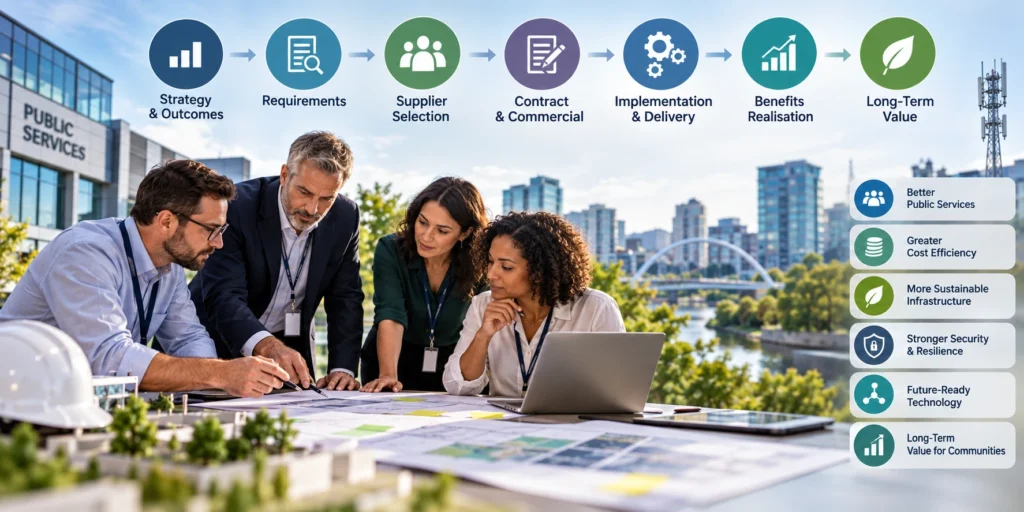
Strategic objectives → Business case → Requirements → Procurement strategy → Contract → Implementation → Benefits realisation
Each stage should reinforce the next.
This lifecycle perspective helps ensure that procurement decisions contribute to measurable organisational outcomes rather than becoming standalone purchasing exercises.
Take a Lifecycle Approach to Public Value
Long-term value comes from looking beyond the procurement event itself.
The strongest approach considers the complete journey: defining the problem, developing the business case, establishing requirements, selecting the right commercial approach, procuring effectively, implementing the solution and managing performance afterwards.
This is particularly important when public money is being invested in infrastructure or technology that may remain in service for many years.
At Spirit Public Sector, this lifecycle perspective is central to the way we support public sector organisations. Our services span strategy and business case development, requirements and procurement, contract implementation and operations, with an emphasis on practical delivery and measurable outcomes.
Conclusion
Effective public sector IT and infrastructure procurement is not simply about finding the lowest-cost supplier or selecting the latest technology.
It is about making informed decisions that deliver sustainable value over time.
That means starting with clear outcomes, understanding whole-life costs, building appropriate flexibility into requirements, embedding security and accessibility, selecting capable delivery partners, establishing robust contracts and measuring whether the promised benefits are actually achieved.
Most importantly, procurement should remain connected to the public service outcomes it is intended to support.
For organisations investing in digital infrastructure and IT services, taking this broader lifecycle approach can help turn procurement from a transactional exercise into a foundation for better, more resilient and more sustainable public services.
At Spirit Public Sector, we work exclusively with public sector organisations to deliver cost-effective, high-impact digital infrastructure, IT services and business solutions designed to maximise taxpayer value and support better outcomes.