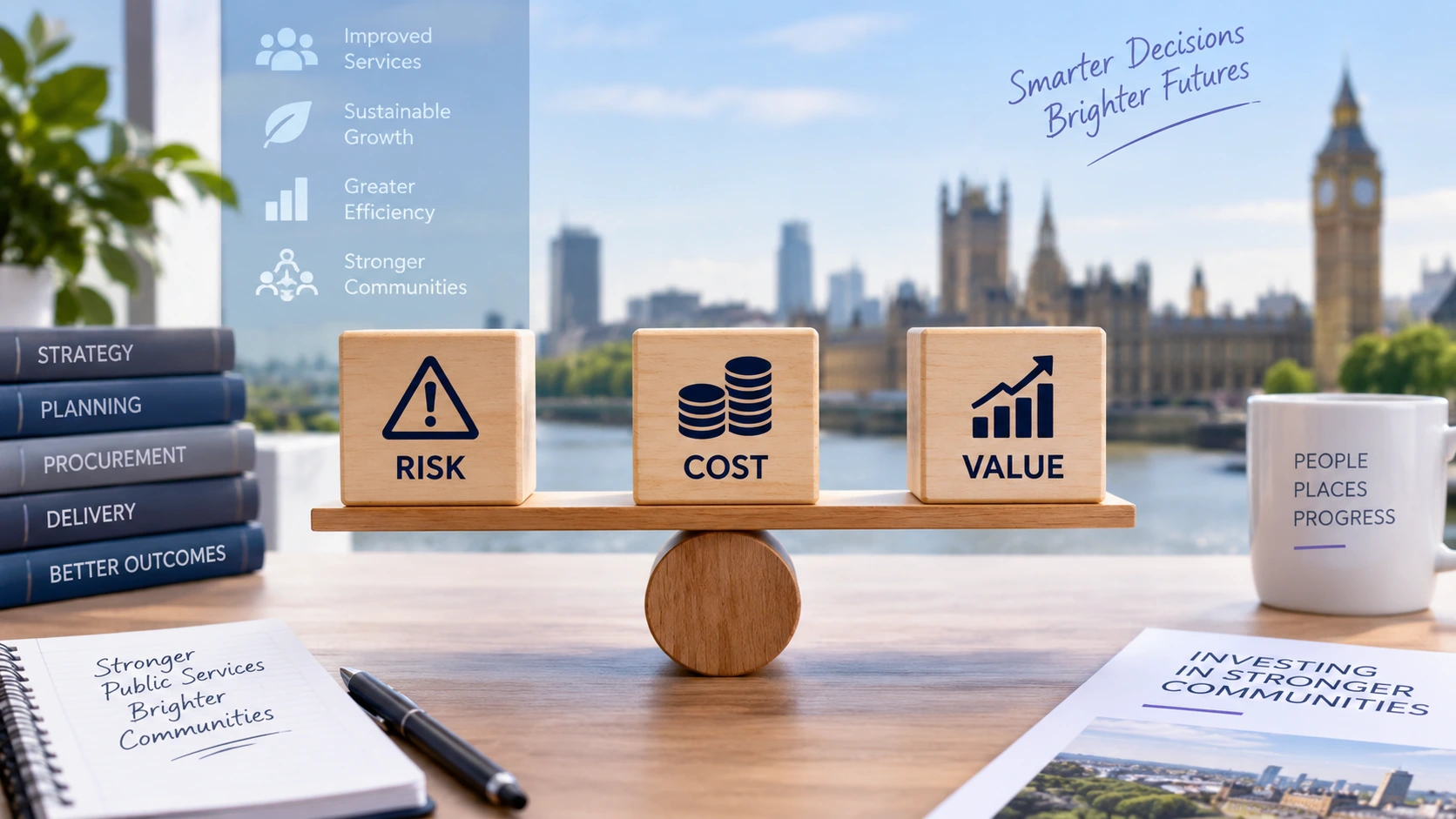
Public sector investment decisions rarely come down to choosing the cheapest option.
Whether an organisation is considering new digital infrastructure, an IT transformation programme, a service improvement initiative, or a major technology investment, the decision must stand up to scrutiny from multiple perspectives. Public money is involved, outcomes need to be demonstrable, risks need to be understood, and the solution ultimately needs to work for the people and communities the organisation serves.
That makes the challenge much broader than comparing initial prices.
A strong investment decision considers risk, cost, and value together. It asks not simply, “What will this cost?” but also, “What will it enable?”, “What could go wrong?”, “What will it cost over its lifetime?”, and “Will the expected benefits actually be achieved?”
For public sector organisations, getting that balance right can determine whether an investment delivers lasting improvement or becomes an expensive project that struggles to meet its original objectives.
Why the cheapest option is not always the best option
Cost is naturally one of the first considerations in any public sector investment decision. Budgets are finite, and organisations have a responsibility to use public money carefully.
However, focusing too heavily on the upfront price can create problems further down the line.
A lower-cost solution may require more maintenance, offer limited scalability, create integration challenges, or become obsolete sooner than a more robust alternative. In digital and technology programmes in particular, an apparently inexpensive option can carry hidden costs in implementation, support, training, upgrades, security, or operational change.
The reverse can also be true. The most expensive proposal is not automatically the one that delivers the greatest benefit.
The better question is whether the investment provides sustainable value over its full lifecycle.
This means looking beyond the initial purchase or implementation cost and considering the wider financial and operational picture. Total cost can include implementation, staffing, support, maintenance, upgrades, training, integration, procurement, transition, and eventual replacement.
When these factors are considered together, the investment decision becomes much more meaningful.
Risk should be considered alongside cost, not after it
Every significant public sector investment carries some degree of risk.
Technology may evolve faster than expected. Supplier performance may vary. Implementation may take longer than planned. Requirements may change. Integration with existing systems may prove more complicated than anticipated. Expected benefits may also take longer to materialise.
The objective is not to eliminate all risk. In many cases, doing so would be unrealistic and could prevent organisations from pursuing valuable opportunities.
Instead, decision-makers need to understand which risks matter, how significant they are, and how they can be managed.
A useful investment assessment should therefore consider questions such as:
- What assumptions is the business case relying on?
- Which risks could materially affect cost or delivery?
- How dependent is the investment on a particular supplier or technology?
- What happens if implementation takes longer than expected?
- How resilient is the proposed solution?
- What controls or mitigation measures are available?
- Who owns each significant risk?
This creates a more realistic view of the investment than a single projected cost figure ever could.
It also helps organisations distinguish between manageable risk and unacceptable risk.
Value means more than financial return
For a commercial organisation, investment value may often be expressed primarily in terms of revenue, profit, or return on investment.
Public sector value is broader.
A successful investment may improve access to services, strengthen infrastructure, increase operational efficiency, improve the experience of citizens and staff, support economic growth, or create better long-term outcomes for a community.
Some benefits will be financial and relatively easy to quantify. Others may be operational, social, strategic, or service-related and require a different approach to assessment.
That does not make those benefits less important.
The key is to define them clearly enough that decision-makers can assess whether the proposed investment is likely to deliver them.
A strong business case therefore connects investment to outcomes. It should make clear what problem is being addressed, what the proposed solution will change, how success will be measured, and how those benefits will be realised over time.
This is particularly important because approving an investment is not the same as delivering its intended value.
Start with the problem, not the technology
One of the most common challenges in technology-led investment is starting with a solution before clearly defining the underlying problem.
A new platform, system, network, or digital service may appear compelling, but technology should support an identified organisational or public-service need.
A stronger approach begins with questions such as:
- What is not working today?
- Who is affected?
- What outcome needs to improve?
- What constraints exist?
- What would success look like?
- What alternatives are available?
These questions help prevent investment decisions from becoming technology-led exercises in search of a business justification.
For public sector organisations, the goal should be to identify the option that best addresses the underlying need while balancing affordability, feasibility, risk, and expected outcomes.
That may sometimes mean choosing a major transformation. In other cases, a smaller intervention, phased programme, or improvement to an existing capability may provide better value.
A strong business case provides the foundation
A robust business case is one of the most important tools for balancing risk, cost, and value.
It gives decision-makers a structured way to understand the case for investment and compare realistic options before significant resources are committed.
A good business case should help answer five fundamental questions:
What is the case for change?
There should be a clear understanding of the problem, opportunity, or public-service need.
What options are available?
Decision-makers should be able to see credible alternatives rather than simply being presented with a preferred solution.
What will each option cost?
Costs should be considered realistically and across the relevant lifecycle, rather than relying solely on headline implementation figures.
What benefits and risks are associated with each option?
Expected outcomes need to be balanced against uncertainty and delivery risk.
How will the preferred option actually be delivered?
A compelling strategic case is of limited value if the organisation has no practical path to implementation.
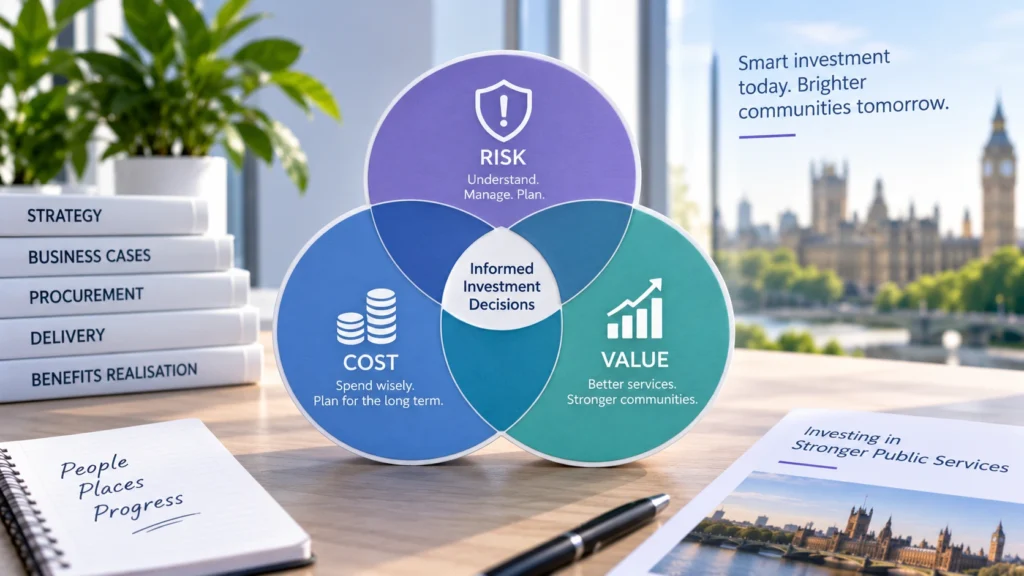
This is where good analysis becomes particularly important. Assumptions should be visible, estimates should be tested, and uncertainty should be acknowledged rather than hidden.
Look beyond the investment decision itself
A common mistake is treating approval as the finish line.
In reality, the decision to invest is only the beginning.
Once an investment has been approved, the organisation still needs to procure the appropriate solution, establish effective contractual arrangements, manage implementation, oversee suppliers, support operational adoption, and track whether the promised benefits are being delivered.
This is why benefits realisation matters.
A project can be delivered on time and within budget yet still fail to produce the intended organisational outcome. A system can technically go live without delivering the expected efficiencies. A new capability can be implemented without achieving the anticipated improvement in citizen experience.
Measuring outcomes after implementation helps organisations understand whether the investment is performing as expected and where corrective action may be required.
It also creates a stronger foundation for future investment decisions.
Procurement should reinforce the investment case
Once an organisation has identified its preferred approach, procurement becomes another critical part of achieving value.
A poorly defined requirement can make it difficult to compare suppliers properly. An unsuitable contract can create unnecessary commercial or operational risk. A short-term focus on price can also result in a solution that does not meet the organisation’s longer-term needs.
Effective procurement should therefore reflect the investment strategy.
Requirements need to be clear, practical, and aligned with the outcomes the organisation is seeking. Commercial arrangements should provide an appropriate balance between cost, performance, flexibility, accountability, and risk.
The objective is not simply to procure a product or service. It is to establish an arrangement that supports successful delivery and sustainable value.
Consider the whole lifecycle
Public sector investment decisions should not stop at implementation.
For digital infrastructure, IT, and other technology-enabled programmes, the lifecycle can span many years. Decisions made at the outset can influence operational costs, scalability, resilience, support requirements, and future flexibility.
A whole-lifecycle perspective encourages organisations to think about:
Implementation: What will it take to introduce the solution successfully?
Operation: What ongoing resources and support will it require?
Adaptation: Can it respond to changing organisational and user needs?
Scalability: Can it grow as demand changes?
Resilience: How well will it perform when circumstances change?
Exit and replacement: What happens when the solution reaches the end of its useful life?
Considering these questions early can reveal risks and costs that may otherwise remain hidden until later stages.
Balance ambition with what can actually be delivered
Public sector organisations should be ambitious about the outcomes they want to achieve. At the same time, ambition needs to be matched with practical delivery capability.
A technically impressive strategy is of limited value if requirements are unclear, governance is weak, resources are unavailable, or implementation arrangements are unrealistic.
This is why practical insight matters.
Investment decisions should reflect the organisation’s actual capabilities, constraints, dependencies, and operating environment. A phased approach may sometimes be more appropriate than attempting to deliver everything at once. Smaller stages can provide opportunities to test assumptions, learn from implementation, manage risk, and demonstrate early benefits.
The right approach will vary from one organisation to another.
What matters is ensuring that the investment strategy and delivery approach are aligned.
Make value a continuing discipline
Balancing risk, cost, and value should not be treated as a one-off exercise undertaken solely to secure approval.
It should remain part of the investment lifecycle.
As circumstances change, assumptions may need to be revisited. Costs may change. Risks may emerge or reduce. Priorities may shift. Expected benefits may become clearer as implementation progresses.
Continued review allows organisations to respond to these changes rather than relying on assumptions made months or years earlier.
It also supports better accountability. When investment decisions are linked to clearly defined outcomes and measurable benefits, organisations are better positioned to demonstrate whether public money is producing the intended results.
A more confident approach to public sector investment
Public sector investment is rarely about finding an option with zero risk or the lowest possible cost.
It is about making a well-informed choice that delivers the strongest overall value within the organisation’s constraints and responsibilities.
That requires a connected approach: understanding the problem, developing credible options, assessing whole-life costs, identifying and managing risks, defining measurable benefits, establishing a strong business case, procuring effectively, and maintaining focus on outcomes through implementation and beyond.
For organisations investing in digital infrastructure, IT transformation, business solutions, or wider public-service improvement, this joined-up perspective can make the difference between simply completing a project and delivering meaningful, lasting change.
At Spirit Public Sector, our approach is built around working alongside public organisations to develop strategies and business cases, define practical requirements, support procurement, assist with implementation and operations, and help realise the benefits of investment. Our focus is on combining sector insight, technology, data, and pragmatic delivery to help public sector organisations make smarter decisions and achieve better outcomes.
Ultimately, the strongest investment decisions are not those that promise the most. They are the ones where risk is understood, cost is realistic, and value is clearly connected to the outcomes that matter.