Digital infrastructure has become a fundamental part of how regions grow, compete and deliver public services. Reliable connectivity, modern IT systems, accessible digital services and better use of data can help communities become more connected, businesses become more productive and public organisations make better-informed decisions.
For local authorities and other public-sector organisations, investing in digital infrastructure is therefore about more than technology. Done strategically, it can create the foundations for economic development, improve access to opportunity and help communities become more resilient and connected.
At Spirit Public Sector, we work exclusively with public-sector organisations to develop smarter, more connected solutions that improve services, maximise taxpayer value and support economic growth.
What is smart digital infrastructure?
Smart digital infrastructure brings together the physical and digital systems that enable people, organisations and public services to connect and operate effectively.
This can include:
- High-quality broadband and mobile connectivity
- Advanced wireless networks
- Public-sector IT infrastructure
- Digital platforms and services
- Data and information systems
- Connected technologies and sensors
- Digital transformation programmes
- Cybersecurity and resilient systems
- Digital infrastructure strategies and business cases
The value comes not simply from deploying individual technologies, but from understanding how they work together to support wider economic, social and public-service objectives.
A well-developed digital infrastructure strategy can help public organisations move from individual technology projects towards a coordinated approach that supports long-term regional priorities.
Why digital connectivity matters for regional economies
Businesses increasingly depend on reliable digital connectivity for everything from communication and cloud applications to online sales, remote working and access to specialist markets.
Where connectivity is limited or inconsistent, businesses and communities can face barriers to participation in the digital economy. Improving infrastructure can help create a more supportive environment for businesses, workers and residents.
The benefits can extend beyond businesses themselves.
Better connectivity can support:
Business growth
Digital connectivity enables businesses to access customers, suppliers, employees and services across wider geographical areas. For smaller businesses in particular, reliable infrastructure can reduce some of the disadvantages associated with operating outside major urban centres.
Access to employment
Digital connectivity can support flexible and remote working, helping people access employment opportunities without always needing to travel long distances.
Innovation and investment
Regions with modern digital infrastructure can provide a stronger platform for organisations adopting new technologies, developing digital services and investing in innovation.
Public-service accessibility
Digital infrastructure can make it easier for residents to access information and public services, while helping public organisations develop more efficient ways of working.
More connected communities
Connectivity can help reduce digital exclusion when it is accompanied by accessible services, appropriate support and consideration of the needs of different communities.
From connectivity to economic development
Simply installing infrastructure does not automatically create economic growth.
The strongest outcomes come when digital infrastructure is connected to a wider regional strategy.
For example, a local authority considering investment in improved connectivity may need to understand:
- Where connectivity gaps exist
- Which communities and businesses are affected
- What future demand could look like
- How infrastructure investment aligns with economic-development priorities
- What funding opportunities are available
- How procurement can deliver value for money
- How benefits will be measured over time
This is where strategic planning and robust business cases become particularly important.
Spirit Public Sector supports public organisations with strategy and business-case development, helping establish the foundations for successful projects.
Making better use of data
Smart digital infrastructure also creates opportunities to use data more effectively.
Public organisations generate and manage significant amounts of information through their services, infrastructure and interactions with communities. Bringing relevant data together can provide better insight into demand, performance and emerging challenges.
Better use of data can support:
- More informed strategic decisions
- Improved service planning
- Identification of infrastructure priorities
- Measurement of programme outcomes
- More effective allocation of resources
- Evidence-based investment decisions
The objective should not be technology for its own sake. Data and digital tools should help public organisations answer practical questions and make decisions that improve outcomes for communities.
Spirit Public Sector’s approach reflects this principle: using technology, data and fresh thinking to support smarter decisions and better results, from strategy through to implementation.
Digital infrastructure and regional inclusion
Economic growth is most meaningful when communities can participate in it.
Digital exclusion can arise from a combination of factors, including availability of infrastructure, affordability, digital skills and accessibility. Consequently, regional digital strategies need to consider people as well as technology.
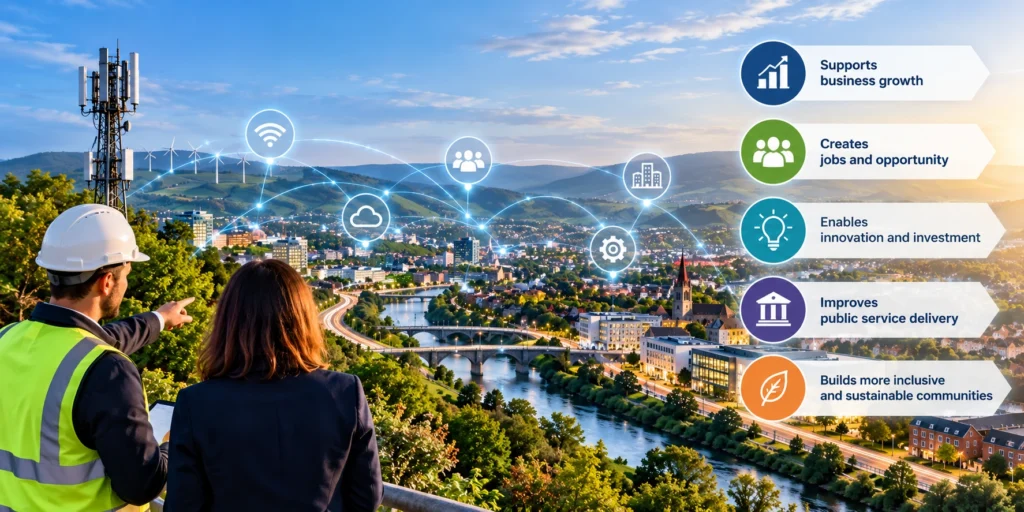
Public-sector organisations can play an important role in ensuring digital transformation remains people-focused.
This means asking questions such as:
- Who benefits from the proposed investment?
- Which communities could remain underserved?
- Are digital services accessible to people with different needs?
- What support is required for residents who may struggle to engage digitally?
- How can physical and digital channels work together?
Spirit Public Sector places the end user at the centre of its approach, recognising that better public services should ultimately contribute to stronger communities.
Turning strategy into delivery
A digital strategy only creates value when it can be translated into practical delivery.
That requires public organisations to consider the complete lifecycle of a programme — from identifying the opportunity and developing the business case through procurement, implementation, operations and benefits realisation.
Each stage presents different challenges.
A strong business case needs to establish the rationale for investment and demonstrate how the proposed approach supports organisational and regional objectives.
Effective procurement needs clear requirements and contracts that are practical, robust and capable of delivering the intended outcomes.
Implementation requires strong programme management, stakeholder coordination and appropriate governance.
Finally, benefits realisation provides a mechanism for understanding whether the investment is delivering the outcomes originally intended.
Spirit Public Sector brings full lifecycle experience and pragmatic insight to projects, supporting clients from strategy and procurement through contract implementation and operations.
Building the foundations for sustainable growth
Digital infrastructure investment should also be considered alongside wider sustainability objectives.
Modern infrastructure can support more efficient ways of working and help public organisations consider environmental impacts alongside financial and service outcomes.
For regional leaders, this means looking beyond the initial deployment of technology and considering its longer-term contribution to a place.
A sustainable digital infrastructure strategy should consider:
- Long-term demand – how requirements may evolve as technology, services and user expectations change.
- Scalability – whether infrastructure can adapt as communities and economies grow.
- Resilience – how services can remain available when systems experience disruption.
- Value for money – whether investment delivers meaningful public benefit.
- Inclusion – whether different communities can access and benefit from digital services.
- Environmental considerations – how infrastructure and technology decisions align with sustainability ambitions.
Taking this broader perspective can help public organisations avoid treating digital infrastructure as a standalone technology issue.
Collaboration is essential
Regional digital transformation rarely sits within the responsibility of one organisation.
Local authorities, government bodies, healthcare providers, businesses, infrastructure providers, communities and other stakeholders can all have a role to play.
Effective collaboration can help organisations develop a shared understanding of regional challenges, coordinate investment and identify opportunities that may be difficult to achieve independently.
Spirit Public Sector’s model is built around working alongside public organisations rather than simply delivering isolated projects. Its stated approach is based on collaboration, transparency, measurable impact and long-term partnerships.
This collaborative approach is particularly relevant to complex digital infrastructure programmes, where technical, financial, commercial and community considerations often overlap.
Measuring the impact
Economic growth and digital transformation should be supported by measurable objectives.
Depending on the programme, public organisations may consider measures relating to:
- Connectivity availability and quality
- Business engagement
- Service accessibility
- Digital adoption
- Programme delivery
- Cost savings or efficiencies
- User experience
- Investment enabled
- Social and community outcomes
The precise measures will depend on the objectives of the programme.
The important point is to establish the intended outcomes early and create mechanisms for tracking progress. This helps decision-makers understand whether a programme is delivering the value anticipated when the investment was approved.
A strategic opportunity for public-sector leaders
Smart digital infrastructure should be viewed as an enabler of wider regional ambitions rather than an end in itself.
For public-sector leaders, the opportunity is to connect infrastructure investment with the priorities that matter most to their communities: stronger local economies, accessible public services, innovation, inclusion, resilience and sustainable development.
Achieving this requires more than choosing the right technology. It requires a clear strategy, robust evidence, effective procurement, strong delivery and a focus on measurable outcomes.
At Spirit Public Sector, our purpose is to help public organisations navigate these challenges through innovative business solutions, technology and strategic insight. We work exclusively with the UK public sector and focus on delivering smarter, more connected solutions that improve lives and strengthen communities.
Looking ahead
The regions that benefit most from digital transformation will not necessarily be those that adopt the most technology. They will be those that use technology thoughtfully to address real economic and public-service challenges.
For local authorities and other public organisations, that means developing digital infrastructure strategies around people, places and outcomes.
By combining strategic planning, reliable infrastructure, effective procurement, strong programme delivery and meaningful benefits measurement, public-sector organisations can build digital foundations that support their communities today while preparing them for the demands of tomorrow.
Smart digital infrastructure is ultimately about creating the conditions for people, organisations and communities to connect, participate and grow.