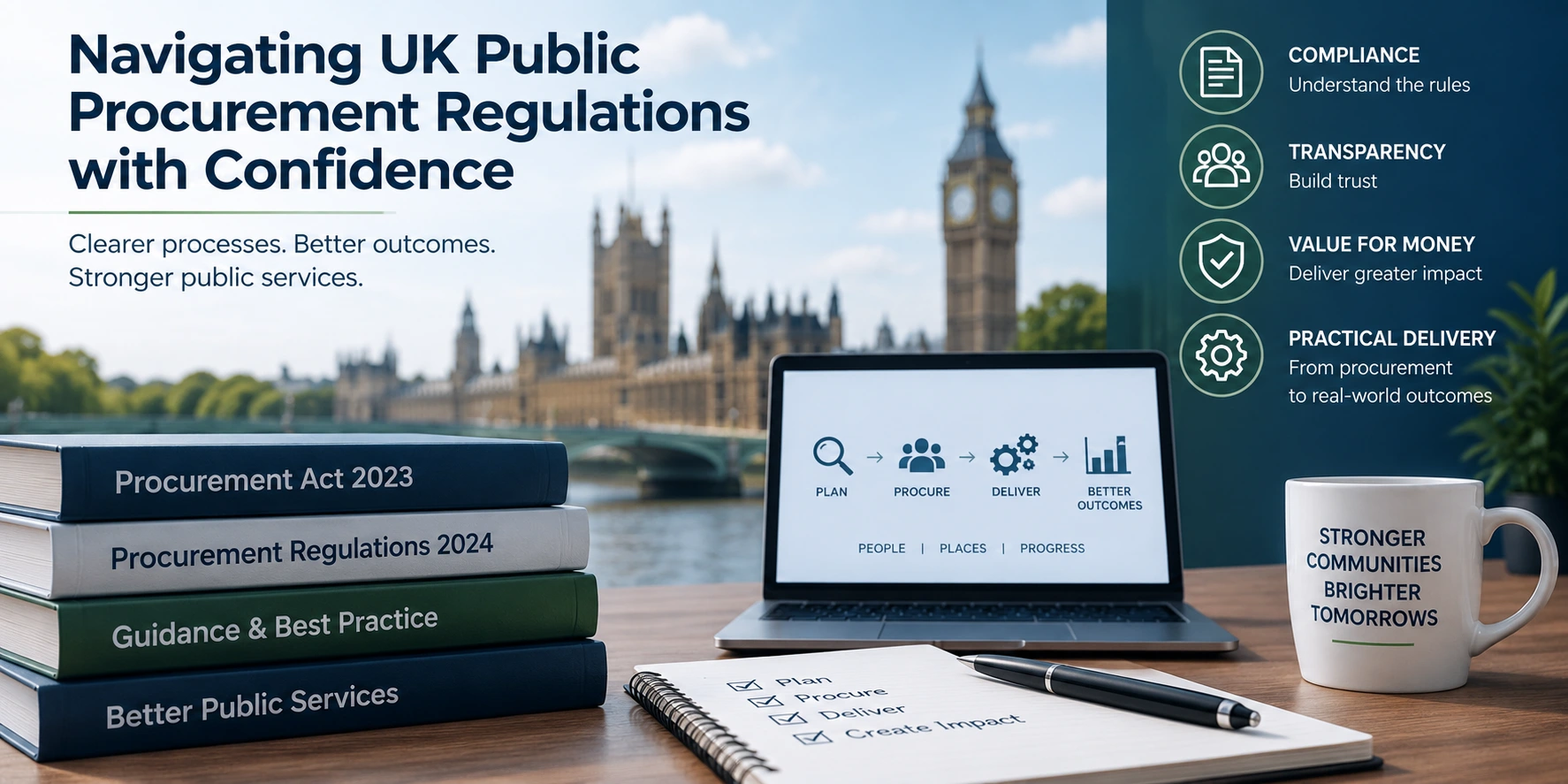
Public procurement is about far more than buying goods and services. For public sector organisations, every procurement decision needs to balance value for money, transparency, fairness, compliance and the delivery of better outcomes for citizens.
As procurement becomes increasingly important to digital transformation, infrastructure, technology and public service improvement, understanding the regulatory landscape is essential. A well-designed procurement can create a strong foundation for successful delivery. A poorly planned one can result in delays, increased costs, contractual difficulties and outcomes that fall short of expectations.
For public sector organisations, the challenge is not simply understanding the rules. It is knowing how to apply them in a practical way while keeping the wider objectives of the project firmly in view.
Understanding the UK Public Procurement Landscape
The UK’s public procurement framework has evolved significantly in recent years.
For procurements covered by the Procurement Act 2023, the new regime came into force on 24 February 2025, replacing the previous EU-derived procurement legislation for most procurements within its scope in England, Wales and Northern Ireland.
The Act places strong emphasis on principles such as transparency, integrity, fair treatment of suppliers and delivering value for money. It also introduces changes to how contracting authorities approach procurement procedures, supplier information, contract management and transparency.
However, there is no single procurement regime covering every public organisation across the UK. Scotland operates under its own procurement legislation, including the Procurement Reform (Scotland) Act 2014 and associated regulations. Organisations therefore need to understand which rules apply to their particular procurement before beginning the process.
For public sector teams, this makes early planning particularly important.
Procurement Starts Before the Tender
One of the most common misconceptions is that procurement begins when a tender is published.
In reality, successful procurement starts much earlier.
Before approaching the market, a public sector organisation should have a clear understanding of:
- The problem it is trying to solve
- The outcomes it needs to achieve
- The scope and requirements of the project
- Available funding and affordability
- The appropriate procurement route
- The market and potential supplier landscape
- Key risks and dependencies
- How value for money will be assessed
- How the resulting contract will be managed
This is particularly important for complex projects involving digital infrastructure, IT services, telecommunications or transformation programmes.
A procurement cannot compensate for unclear requirements. If the underlying business need has not been properly defined, suppliers may respond to different interpretations of the requirement, making evaluation more difficult and increasing the risk of scope changes later.
That is why requirements definition and business case development should be treated as fundamental parts of procurement planning, rather than separate exercises.
Getting the Requirements Right
Clear requirements provide the foundation for a competitive and effective procurement.
Requirements should explain what the organisation needs to achieve without unnecessarily restricting how suppliers can deliver it. For technology and digital projects, this can mean focusing on outcomes, interoperability, resilience, security, accessibility and scalability rather than prescribing a particular product or technical solution without good reason.
Good requirements should be:
- Clear – suppliers should be able to understand what is required.
- Measurable – expected outcomes and service levels should be capable of being assessed.
- Proportionate – requirements should reflect the size, complexity and risk of the procurement.
- Outcome-focused – where appropriate, the emphasis should be on what the public sector needs to achieve rather than simply what it needs to purchase.
- Practical – requirements need to work in the real-world operating environment.
Getting this balance right can encourage meaningful competition while giving suppliers enough clarity to develop robust proposals.
Choosing the Right Procurement Approach
There is no universal procurement approach that works for every public sector project.
The appropriate route will depend on factors including the nature and complexity of the requirement, market conditions, value, risk and the applicable procurement regime.
Under the Procurement Act 2023, contracting authorities have greater flexibility in designing competitive procedures than under the previous regime. However, flexibility does not remove the need for careful planning, transparency and consistency.
For complex requirements, a well-designed procurement process should give the market an appropriate opportunity to demonstrate how it can deliver the required outcomes.
The goal should not simply be to run a compliant procurement. It should be to create a procurement process that gives the organisation the best realistic opportunity to achieve its strategic objectives.
Transparency and Fairness Matter
Public procurement decisions must be capable of standing up to scrutiny.
Taxpayers, elected members, suppliers, auditors and other stakeholders may all have an interest in how public money is spent. Transparency therefore needs to be considered throughout the procurement lifecycle.
This includes having a clear audit trail for important decisions, applying evaluation criteria consistently and ensuring that suppliers are treated fairly.
Transparency is not simply a regulatory requirement. It can also strengthen trust in the procurement process and make it easier for organisations to demonstrate why particular decisions were made.
For public bodies operating in complex or politically sensitive environments, this can be especially important.
Think Beyond the Award
A successful procurement does not end when a contract is awarded.
The contract itself needs to provide a practical framework for delivering the expected outcomes.
Before contract award, organisations should consider how they will manage:
- Performance and service levels
- Key deliverables and milestones
- Reporting and governance
- Risks and dependencies
- Change control
- Data, security and information requirements
- Supplier performance
- Contract variations
- Exit and transition arrangements
This is particularly relevant to long-term digital and technology contracts, where requirements, technology and operating environments can change over time.
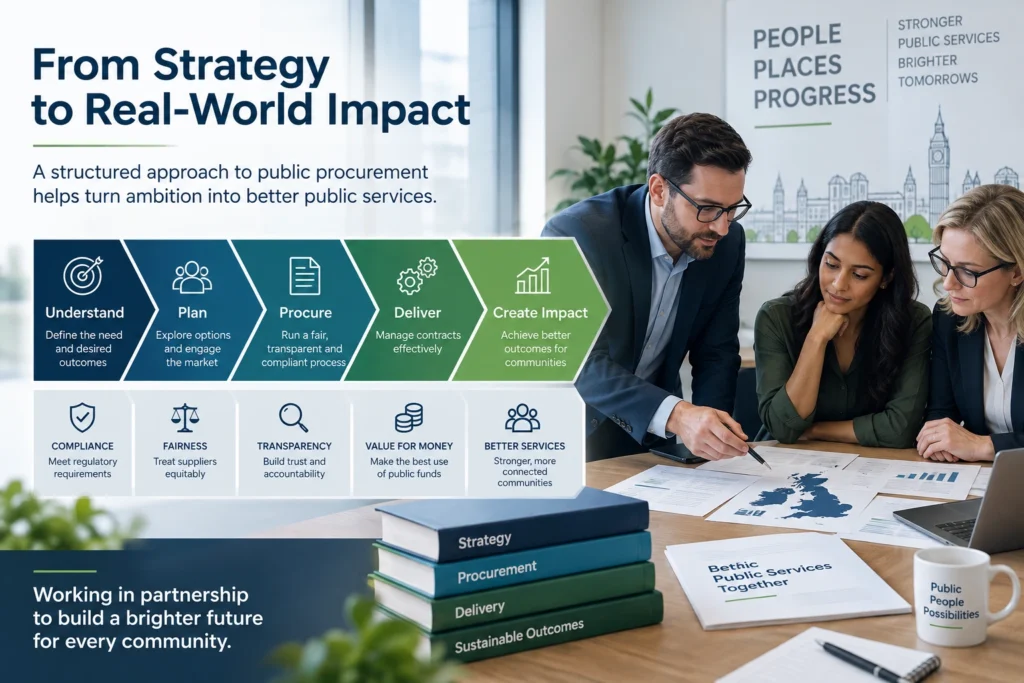
Effective contract management helps ensure that the value anticipated during procurement is actually realised during implementation and operation.
Value for Money Is More Than the Lowest Price
For public sector organisations, achieving value for money does not necessarily mean selecting the cheapest bid.
A procurement decision may need to consider a broader range of factors, including quality, whole-life cost, performance, resilience, risk and the ability of a solution to deliver the required outcomes.
For example, selecting a lower-cost technology solution that requires significant additional investment to integrate, maintain or replace may ultimately provide less value than a solution with a higher initial cost but stronger long-term performance.
This is why procurement should be connected to the wider business case.
The question should be:
What option is most likely to deliver the required outcomes and provide sustainable value for public money?
rather than simply:
Which option costs the least today?
Procurement and Public Sector Transformation
Procurement increasingly plays a strategic role in public sector transformation.
Whether an organisation is investing in digital infrastructure, modernising IT, introducing new technology or developing connected public services, procurement can determine the commercial foundations on which the project is built.
This means procurement professionals, project teams, technical specialists, finance teams and senior decision-makers need to work together.
At Spirit Public Sector, this joined-up approach reflects our wider focus on supporting public organisations from strategy and business case development through requirements definition, procurement, implementation and operations.
Our experience spans areas including advanced wireless, digital infrastructure, IT transformation, digital programme delivery, business case development and procurement support.
Common Procurement Challenges
Even experienced public sector teams can encounter challenges during complex procurements.
1. Starting with the solution rather than the problem
A project can become unnecessarily constrained if an organisation decides on a particular technology or supplier approach before clearly defining the underlying need.
2. Underestimating market engagement
Understanding supplier capability, market maturity and potential delivery models can help organisations develop more realistic requirements and procurement strategies.
3. Overly complicated requirements
Requirements that are unnecessarily prescriptive can restrict competition and make it harder for suppliers to propose innovative solutions.
4. Focusing on procurement rather than delivery
A compliant procurement is only one part of the journey. The resulting contract must be capable of delivering the intended outcomes.
5. Insufficient contract management planning
Without appropriate governance, performance measures and ownership, the benefits anticipated during procurement may not be fully realised.
Building Procurement Confidence
Confidence in public procurement comes from combining compliance with practical delivery experience.
A strong procurement process should provide a clear line of sight from:
Strategic objectives → Business case → Requirements → Procurement strategy → Competition → Contract award → Implementation → Benefits realisation
Each stage should support the next.
When these elements are connected, procurement becomes more than a compliance exercise. It becomes a strategic tool for delivering better public services and making the best possible use of public money.
How Spirit Public Sector Can Help
Navigating procurement regulations can be challenging, particularly when procurement is part of a wider transformation programme involving technology, infrastructure, funding and multiple stakeholders.
Spirit Public Sector works exclusively with public sector organisations, bringing together strategic insight, sector knowledge and practical delivery experience. Our approach is based on collaboration, transparency and a focus on measurable outcomes.
We can support public organisations with strategy and business cases, requirements definition, procurement support, contract implementation and operational delivery. Our aim is to help clients establish robust foundations for successful projects while keeping value, compliance and real-world delivery at the centre of the process.
Looking Ahead
Public procurement will continue to evolve as government seeks greater transparency, better value and stronger public outcomes.
For organisations preparing a significant procurement, the best time to consider compliance, commercial strategy and delivery risk is not when the tender is ready to publish. It is at the beginning of the project.
With the right preparation, procurement can provide more than a route to appointing a supplier. It can create the commercial, technical and governance foundations needed to deliver lasting value for citizens and communities.
Spirit Public Sector helps public organisations turn complex challenges into practical, deliverable solutions.
If your organisation is planning a procurement, developing a business case or preparing for a digital transformation project, get in touch with Spirit Public Sector to discuss how we can help.
Important note
This article provides general information and is not legal advice. Public procurement requirements vary according to the nature of the contracting authority, procurement, jurisdiction and applicable legislation. Organisations should obtain appropriate professional or legal advice where required and refer to the latest official guidance and legislation before commencing a procurement.
Useful official resources
For further information, public sector organisations should consult the latest guidance and legislation published by the relevant government authorities, including:
- GOV.UK – Procurement Act 2023
- GOV.UK – Procurement Regulations 2024
- GOV.UK – Procurement Act 2023 guidance
- Welsh Government – public procurement guidance
- Scottish Government – public procurement guidance, where applicable
- Northern Ireland Executive – public procurement guidance, where applicable