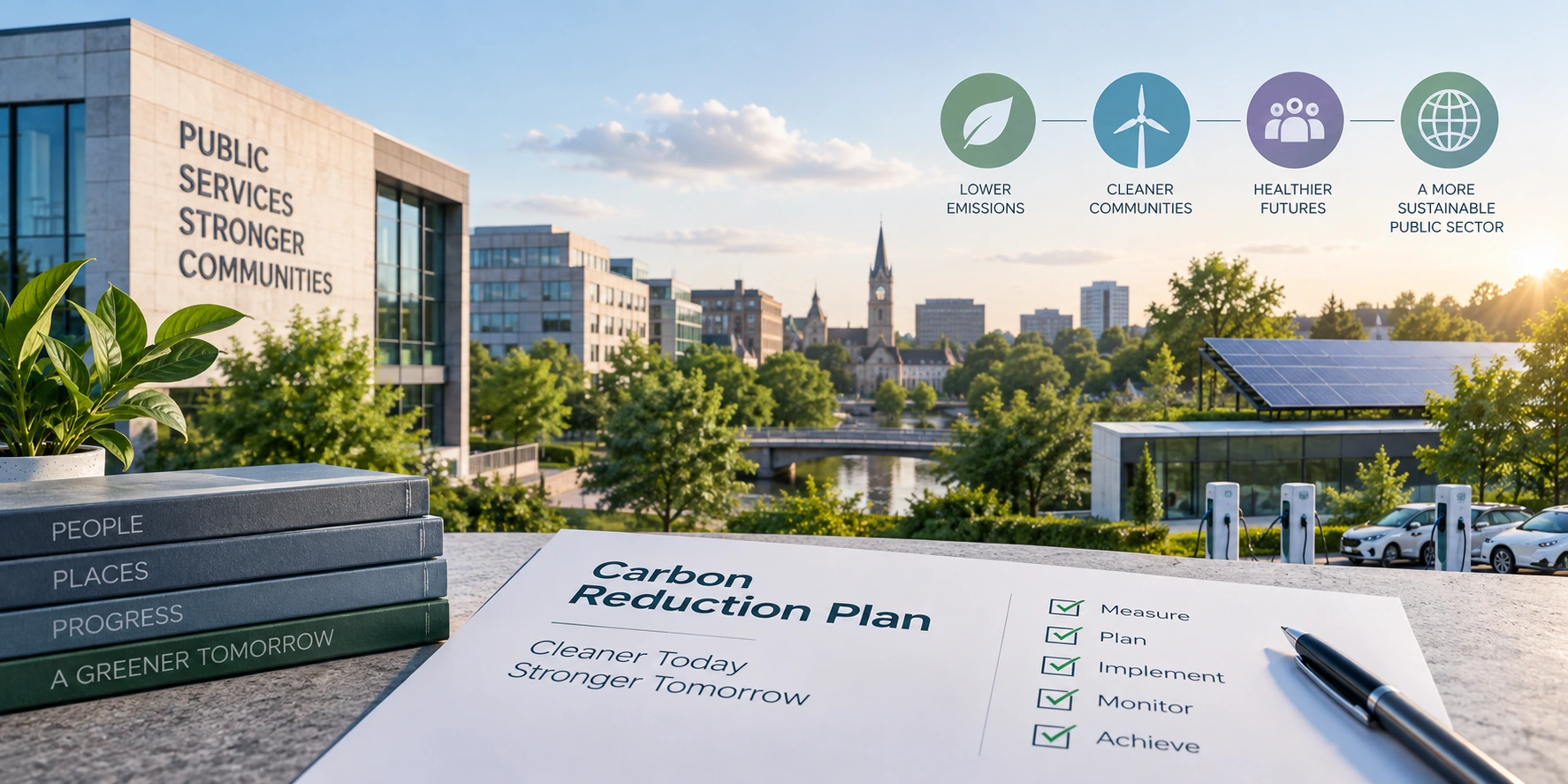
For public-sector organisations, reducing carbon emissions is no longer simply a long-term environmental ambition. It increasingly affects procurement, estates, transport, energy management, financial planning, service delivery and the way organisations work with suppliers.
The challenge is turning that ambition into something practical.
A Public Sector Carbon Reduction Plan (CRP) should do more than state an intention to reduce emissions. It should establish a clear baseline, identify where the greatest reductions can be achieved, assign responsibility, set measurable targets and translate those targets into actions that can be funded and delivered.
For organisations working with limited budgets, complex estates and competing public-service priorities, that process needs to be realistic as well as ambitious.
What is a Public Sector Carbon Reduction Plan?
A Carbon Reduction Plan is a structured framework for understanding an organisation’s greenhouse-gas emissions and setting out how those emissions will be reduced over time.
At its most useful, it connects three things:
Where emissions come from → what needs to change → how that change will be delivered and measured.
The scope of a plan will vary between organisations. A local authority with offices, schools, leisure facilities, housing and a large vehicle fleet will have very different emissions sources from a government body operating from a small number of buildings.
A good plan therefore starts with the organisation itself rather than applying a one-size-fits-all list of sustainability measures.
Typical areas of consideration can include electricity and gas consumption, buildings, fleet and business travel, waste, water, procurement, contracted services and relevant supply-chain emissions.
Start With a Reliable Carbon Baseline
The first step is understanding the current position.
Without a credible baseline, it is difficult to know where the greatest opportunities lie or whether interventions are actually delivering meaningful reductions.
Data may come from utility bills, meter readings, fleet records, fuel purchases, building-management systems, travel expenses, procurement information and supplier data. In some areas, accurate information may already be available. In others, estimates may initially be necessary.
This is where organisations should avoid creating unnecessary complexity.
A useful baseline should be sufficiently robust to support decision-making while being practical to maintain and improve over time. It should also clearly explain the boundaries, assumptions, reporting period and methodologies used.
The baseline should ultimately allow decision-makers to answer straightforward questions:
- Where are our largest emissions coming from?
- Which emissions are within our direct control?
- Where do we have significant influence through procurement or partnerships?
- Which areas offer the greatest realistic potential for reduction?
Once those questions are answered, resources can be directed towards the areas where they are most likely to have an impact.
Identify the Highest-Impact Opportunities
Not every carbon-reduction measure deserves equal priority.
Replacing inefficient lighting may be relatively straightforward, for example, but the potential impact could be smaller than addressing heating across a large property estate. Similarly, introducing a greener business-travel policy may be worthwhile, while fleet decarbonisation could represent a much larger opportunity for an organisation operating hundreds of vehicles.
A carbon reduction plan should therefore prioritise interventions according to both carbon impact and deliverability.
For many public-sector organisations, potential measures may include:
- Improving building insulation and energy efficiency.
- Replacing inefficient heating and cooling systems.
- Increasing the use of renewable or lower-carbon energy.
- Electrifying suitable vehicle fleets and improving charging infrastructure.
- Reducing unnecessary business travel and encouraging lower-carbon alternatives.
- Improving energy monitoring and building controls.
- Reducing waste and increasing reuse.
- Working with suppliers to improve carbon performance.
- Considering whole-life carbon when purchasing assets, equipment and services.
The right mix will depend on an organisation’s estate, operations, contractual arrangements, available capital and local circumstances.
Build the Plan Around Action, Not Just Targets
A target can provide direction, but it does not deliver a reduction by itself.
One of the most common weaknesses in sustainability planning is creating a document filled with aspirations without establishing who is responsible for turning those aspirations into reality.
Every significant action should therefore be connected to an owner, a timescale and a method of measuring progress.
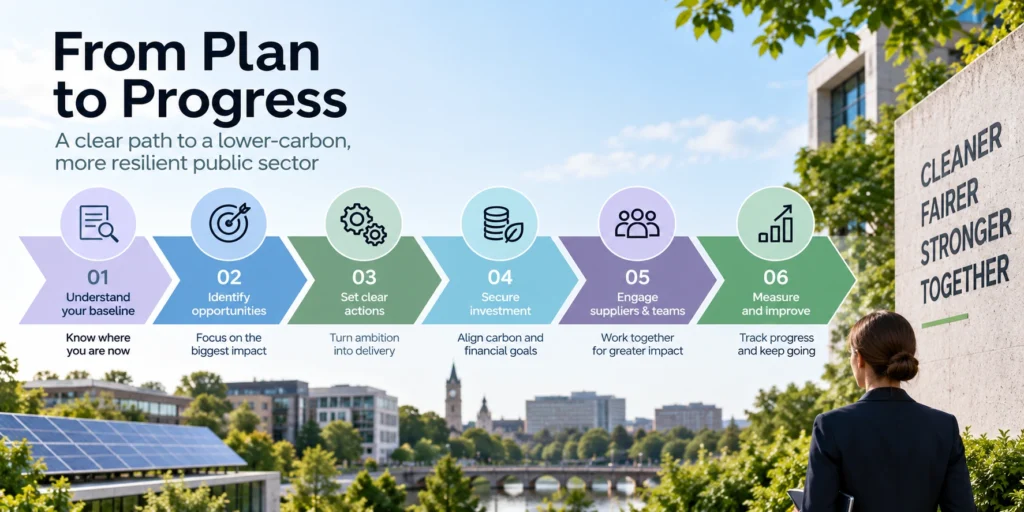
For example, instead of simply stating:
“Reduce emissions from the estate.”
an actionable plan might establish a programme of energy audits, prioritise buildings according to energy performance, identify specific improvement measures, allocate funding and establish a timetable for implementation.
The distinction is important.
A Carbon Reduction Plan should function as a management tool, not simply as a sustainability statement.
Connect Carbon Reduction With Financial Planning
For the public sector, carbon reduction cannot be considered separately from financial pressures.
Many of the most effective interventions require upfront investment. Energy-efficiency improvements, building upgrades, heat decarbonisation, electric vehicles and associated infrastructure can all involve significant capital expenditure.
At the same time, some interventions can reduce operating costs over their lifetime.
This makes business-case development particularly important.
Projects should be assessed not only in terms of their estimated carbon savings, but also through considerations such as capital cost, ongoing operational cost, payback, asset life, resilience, service impact and potential funding opportunities.
A strong plan helps decision-makers understand the relationship between these factors.
It can also help organisations avoid a narrow focus on the cheapest short-term option when a slightly different investment could provide substantially greater long-term benefits.
Consider the Whole Estate and Asset Lifecycle
Buildings are often central to public-sector carbon reduction, but estates should be considered strategically rather than building by building in isolation.
Questions should include how buildings are occupied, how much energy they use, when major maintenance is due, whether assets are approaching the end of their useful life and whether planned refurbishment could incorporate energy and carbon improvements.
Timing matters.
A major refurbishment can provide an opportunity to incorporate measures that might otherwise be significantly more expensive to retrofit later. Similarly, replacing equipment at the end of its useful life can be an opportunity to move towards more efficient alternatives.
This means carbon planning should connect with asset management, capital programmes and planned maintenance, rather than sitting in a separate sustainability workstream.
Procurement Is a Major Part of the Picture
A public-sector organisation’s emissions are not limited to what happens inside its own buildings.
Goods and services purchased from external organisations can represent a substantial part of an organisation’s wider carbon footprint. This makes procurement an important lever for influence.
Carbon considerations can be incorporated into procurement strategies, contract management and supplier engagement, proportionately and appropriately for the requirement.
This might involve asking suppliers for relevant emissions information, understanding how services will be delivered, encouraging lower-carbon approaches or embedding appropriate environmental requirements into contracts.
The objective should not be to create unnecessary barriers for suppliers.
Instead, procurement can be used strategically to encourage better environmental performance while maintaining competition, value for money and service quality.
Make Supply-Chain Emissions More Manageable
Scope 3 and other value-chain emissions can be particularly challenging because organisations often have less direct control over them.
Data may be incomplete, suppliers may use different methodologies, and emissions may be difficult to attribute precisely.
That does not mean they should be ignored.
A sensible approach is to improve understanding progressively.
Start by identifying the most significant categories and suppliers. Establish where reliable data exists and where estimates are required. Then focus engagement on the areas where the organisation has the greatest influence or where the potential impact is greatest.
Over time, better supplier information can improve the accuracy and usefulness of the carbon baseline.
Give the Plan Clear Governance
A Carbon Reduction Plan needs visible ownership.
Senior leadership should understand the objectives, major risks, investment requirements and progress against targets. Operational teams need clarity about the actions they are expected to deliver.
Responsibilities may sit across estates, procurement, finance, transport, facilities management, HR, IT and service teams. Without coordination, individual initiatives can become disconnected and opportunities can be missed.
Governance arrangements should therefore establish:
- Who owns the overall programme.
- Who is responsible for individual actions.
- How decisions about investment are made.
- How progress is reported.
- How risks and delays are escalated.
- How the plan will be reviewed and updated.
Good governance also helps ensure that carbon reduction remains part of mainstream organisational decision-making rather than depending on a single sustainability lead.
Measure Progress Regularly
A plan without regular measurement can quickly become outdated.
Organisations should establish a manageable set of indicators that show whether actions are being delivered and whether emissions are actually moving in the intended direction.
These measures could include overall greenhouse-gas emissions, energy consumption, emissions intensity, building performance, fleet composition, renewable-energy generation or progress against individual programme milestones.
Importantly, not every indicator needs to be reported at the same level of detail.
Senior leaders generally need a clear view of overall progress, major variances, financial implications and key risks. Operational teams may require much more detailed information to manage individual buildings, contracts or projects.
The reporting structure should reflect those different needs.
Treat the Plan as a Living Programme
A Carbon Reduction Plan should not be written once and then placed on a website indefinitely.
Energy prices change. Technology develops. Assets are replaced. Funding opportunities appear and disappear. Procurement arrangements change. Organisational priorities evolve.
A plan that is regularly reviewed can respond to those changes.
This does not necessarily mean rewriting the entire document every year. It means maintaining a clear process for reviewing assumptions, updating emissions data, assessing delivery, reprioritising actions and refreshing the implementation timetable.
That turns the plan from a static document into an ongoing improvement programme.
What Makes a Carbon Reduction Plan Effective?
The strongest public-sector plans tend to share several characteristics.
They are based on a credible understanding of current emissions.
They focus effort on the areas with the greatest potential impact.
They distinguish between actions that can be delivered quickly and those requiring longer-term investment.
They assign responsibility rather than leaving actions as organisational aspirations.
They connect environmental objectives with finance, procurement, estates and operational planning.
And they establish a realistic approach to measuring and communicating progress.
Perhaps most importantly, they recognise that decarbonisation is not a single project.
It is a programme of organisational change.
Turning Strategy Into Delivery
Developing a Carbon Reduction Plan is an important first step, but the real value comes from what happens afterwards.
For public-sector organisations, successful carbon reduction often requires a combination of good data, practical planning, cross-functional collaboration, investment decisions and disciplined delivery.
The objective should not be to produce the most impressive-looking sustainability document. It should be to create a plan that decision-makers can use, teams can act on and stakeholders can understand.
That is where a practical, evidence-led approach can make a difference.
At Spirit Public Sector, we understand that public-sector organisations need solutions that recognise the realities of public procurement, budgets, governance, infrastructure and service delivery. Effective carbon reduction is about balancing environmental objectives with the need to deliver resilient, affordable and high-quality public services.
A well-developed Carbon Reduction Plan provides the roadmap. Effective action turns that roadmap into measurable change.