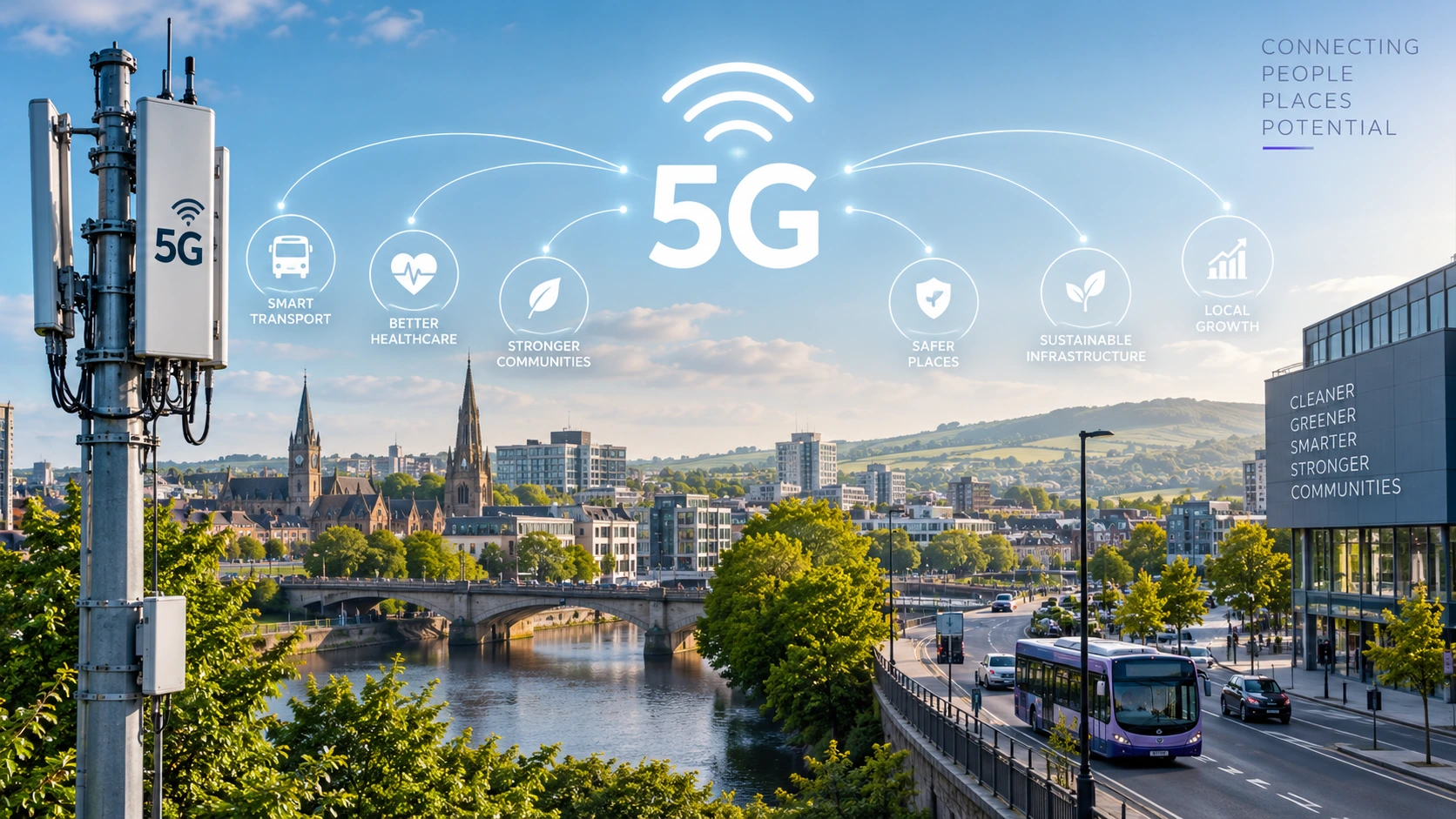
For many years, conversations about digital infrastructure focused on broadband availability and mobile coverage. Those foundations remain essential, but the next stage of the UK’s digital transformation is increasingly about what public services can do with better connectivity.
This is where 5G Innovation Regions (5GIRs) are becoming important.
Across the UK, local and regional public-sector organisations are exploring how 5G can support better transport, healthcare, emergency response, agriculture, environmental monitoring, public services and local economic development. Rather than treating 5G simply as a faster mobile connection, these programmes are looking at how advanced wireless technologies can become part of the infrastructure that communities depend on.
For local authorities and other public-sector organisations, that creates both an opportunity and a challenge. The opportunity is to rethink how services are delivered. The challenge is turning individual technology trials into reliable, scalable infrastructure that delivers lasting public value.
At Spirit Public Sector, we work exclusively with public-sector organisations and support projects involving digital infrastructure, technology, business cases, procurement and programme delivery. Our experience working alongside public organisations reinforces an important principle: successful digital infrastructure is not defined by the technology alone. It is defined by the outcomes it enables.
What are 5G Innovation Regions?
The 5G Innovation Regions programme was established to encourage regions across the UK to develop practical applications for advanced wireless connectivity.
The emphasis is important. Instead of deploying technology simply because it is new, 5GIR programmes focus on identifying local challenges and exploring where 5G and related technologies can provide a meaningful solution.
This can include technologies such as private 5G networks, Internet of Things (IoT) devices, connected sensors, edge computing and other forms of advanced wireless connectivity.
The approach also recognises something that local authorities understand well: infrastructure needs vary considerably from one place to another.
A predominantly rural region may be interested in connecting agricultural machinery, monitoring remote assets or improving connectivity for isolated communities. A densely populated urban area may be more focused on intelligent transport, public safety, healthcare or digitally enabled town centres.
That local focus is one of the strongest features of the 5G Innovation Regions model.
Why 5G Matters to Local Infrastructure
The significance of 5G is not simply that it can deliver higher speeds than previous generations of mobile connectivity.
For public infrastructure, the more interesting characteristics are low latency, high capacity, connectivity for large numbers of devices and the potential to create dedicated or private network environments.
Combined with sensors, cameras, automation and data platforms, these capabilities can support infrastructure that is more responsive and better informed.
Imagine a local authority managing roads and public spaces using thousands of connected devices. Sensors could provide information about traffic conditions, environmental conditions, parking availability or the condition of physical assets. That information could feed into operational systems, helping teams understand what is happening in near real time.
The value comes from the complete system rather than the network alone.
5G provides part of the connectivity layer. Sensors generate information. Software processes it. Data supports decision-making. Public-sector teams use those insights to change how services operate.
This is why 5G projects should be viewed as part of a broader digital infrastructure strategy, rather than as standalone telecommunications projects.
Transforming Transport and Mobility
Transport is one of the areas where connected infrastructure could have a particularly visible impact.
Local authorities are already responsible for increasingly complex transport environments involving roads, buses, parking, traffic management, active travel and public realm infrastructure.
5G-enabled technologies could help connect vehicles, roadside equipment and sensors to create more responsive transport systems.
Potential applications include real-time traffic monitoring, connected public transport, intelligent traffic signals, automated incident detection and improved information for transport operators.
For communities, the objective is not simply to introduce more technology. It is to make journeys safer, more efficient and more accessible.
For local authorities, connected transport infrastructure could also create better visibility across geographically dispersed assets.
This is particularly relevant as councils seek to manage budgets carefully. Better information can help organisations target maintenance, understand demand and prioritise investment instead of relying entirely on periodic inspections or fragmented datasets.
Supporting Healthcare and Social Care
The combination of advanced connectivity and digital services also has significant implications for healthcare and social care.
A connected environment can help healthcare providers, local authorities and other public bodies explore models that reduce reliance on physical locations where appropriate.
Remote monitoring, connected medical devices, assisted living technologies and mobile health services are examples of areas where reliable connectivity can support different ways of working.
For rural and geographically dispersed communities, the potential benefits can be particularly significant.
However, public-sector healthcare applications also demonstrate why technology deployment must be accompanied by careful planning.
Connectivity alone does not create better healthcare. Organisations need appropriate governance, security, accessibility, data management, procurement arrangements and operational processes.
The strongest projects therefore begin with the service challenge rather than the technology.
Improving Emergency Response and Public Safety
When an incident occurs, the ability to share accurate information quickly can be critical.
Advanced wireless networks can support connected cameras, sensors, vehicles and other devices that help emergency and public-service teams understand changing situations.
For example, connected systems could support monitoring of environmental conditions, transport disruptions, public spaces or critical infrastructure.
The potential benefit is greater situational awareness.
Instead of relying exclusively on manually gathered information, teams can potentially receive a continuous stream of data from multiple sources. That can support faster decision-making and more coordinated responses.
Again, the objective should not be to collect data simply because it is available. The system has to answer a practical question: what information will help the organisation make a better decision?
Unlocking Opportunities in Rural Areas
The discussion around digital infrastructure can sometimes be dominated by major cities, but some of the most interesting applications of 5G may emerge in rural and semi-rural communities.
Agriculture, environmental monitoring, forestry, utilities and remote asset management all present situations where traditional connectivity models can be challenging.
Connected agricultural equipment, autonomous machinery, sensors and drones could potentially provide farmers and land managers with more detailed information about operations and environmental conditions.
For local and regional government, this can connect digital infrastructure investment with wider economic and sustainability objectives.
It also highlights an important point about regional innovation: there is no single 5G use case that will work everywhere.
The right approach for a rural region may look completely different from the approach required in a large metropolitan area.
From Demonstration Project to Real Infrastructure
One of the biggest questions facing 5G Innovation Regions is what happens after a successful trial.
A demonstration can show that something is technically possible. A public service, however, needs something that is reliable, maintainable, secure, affordable and scalable.
This transition from pilot to operational service is where many technology programmes become considerably more complex.
A successful project may require:
- a clear business case
- defined service and technical requirements
- appropriate procurement arrangements
- integration with existing systems
- cybersecurity and data governance
- operational ownership
- funding for ongoing support
- measurable benefits
- a realistic approach to scaling
These considerations should be addressed from the beginning rather than after a pilot has finished.
For public-sector organisations, this is especially important because infrastructure decisions can have long-term financial and operational consequences.
A project may demonstrate impressive technology but still struggle to justify wider investment if the ongoing costs, responsibilities and benefits have not been clearly established.
Building the Business Case for 5G
Technology projects can sometimes begin with an attractive proposition: What could we do with 5G?
Public-sector investment needs to go further.
The more useful question is: Which outcomes could advanced connectivity deliver that justify the investment?
That means establishing a clear baseline, identifying the problem being addressed and defining how success will be measured.
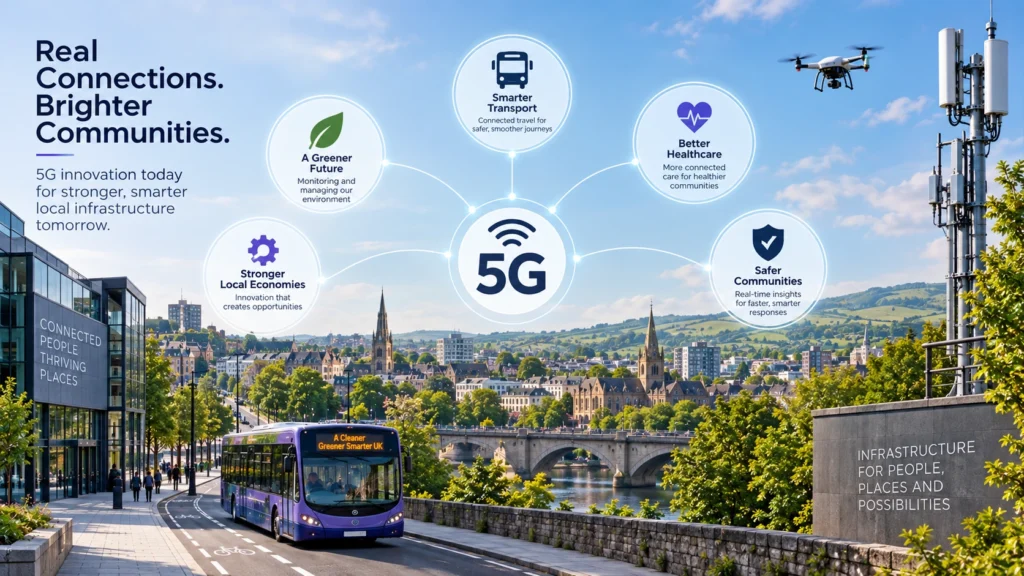
Depending on the project, benefits could include improved service access, reduced operational costs, better asset management, improved safety, greater productivity, reduced environmental impact or stronger local economic activity.
A robust business case should also consider alternatives.
5G will not automatically be the right solution for every connectivity challenge. Fibre, Wi-Fi, existing mobile networks, low-power wide-area technologies and other solutions may sometimes be more appropriate.
The goal should be to choose the technology that best supports the required outcome, not to retrofit a problem around a particular technology.
The Importance of Procurement and Partnerships
5G-enabled infrastructure typically sits across several boundaries.
Local authorities may need to work with technology providers, network operators, infrastructure companies, software suppliers, transport organisations, healthcare providers, universities and other partners.
This makes procurement and partnership design particularly important.
Clear requirements are needed so that public organisations can purchase solutions that are practical, interoperable and capable of evolving over time.
Contracts also need to reflect the realities of digital infrastructure. Issues such as ownership, data, service levels, maintenance, interoperability, security, scalability and exit arrangements can become critical as a pilot develops into a long-term service.
For public bodies, the objective should be more than simply procuring equipment. It is about creating a sustainable framework for delivering the intended public benefit.
Why Regional Collaboration Matters
Another important characteristic of the 5G Innovation Regions approach is that innovation does not have to happen within organisational boundaries.
Local authorities and regional bodies can share learning, develop common approaches and explore opportunities for infrastructure that crosses administrative areas.
This can be especially valuable where transport networks, economic activity and digital services extend beyond a single council boundary.
Collaboration can also reduce duplication.
A technology trial in one area may provide useful lessons for another, even when the specific use case is different. Sharing lessons about procurement, governance, technical standards, benefits measurement and implementation can help future projects progress more effectively.
For public-sector organisations working under financial pressure, making better use of shared knowledge can be just as valuable as investing in new technology.
What Should Local Authorities Do Next?
For organisations considering how 5G could contribute to their own infrastructure plans, the starting point should not necessarily be a network deployment.
It should be an assessment of where connectivity is currently limiting service performance or creating new opportunities.
That could mean looking at transport, public estates, environmental monitoring, social care, economic development, emergency response or internal operations.
From there, organisations can identify the use cases with the strongest combination of public benefit, technical feasibility and financial viability.
The most effective programmes are likely to take a whole-system view.
That means considering technology alongside business processes, skills, procurement, governance, funding and long-term operations.
It also means being realistic about scale. Not every successful pilot needs to become a region-wide deployment. Some trials will demonstrate that an idea is unsuitable. That is not necessarily failure. It is part of making evidence-based investment decisions.
A More Connected Future for UK Public Services
5G Innovation Regions represent an important shift in the way digital infrastructure can be approached at a local level.
The opportunity is not simply to give communities faster wireless connectivity. It is to create the foundations for smarter, more connected public services that use data and technology to respond more effectively to real-world needs.
For local authorities and other public organisations, the question is therefore less about whether 5G is innovative and more about where innovation can create measurable value.
Getting that right requires a combination of technology knowledge, sector understanding, commercial thinking and disciplined delivery.
That is the space where organisations like Spirit Public Sector can add value: helping public-sector partners move from strategic ideas to practical programmes, robust business cases, effective procurement and successful implementation.
The next generation of local infrastructure will not be defined by connectivity alone. It will be defined by what better connectivity enables communities and public services to achieve.
Building Smarter Digital Infrastructure
The UK’s 5G journey is ultimately about much more than telecommunications. It is about how regions can use technology, data and innovation to improve the way places work and public services are delivered.
For councils and public-sector organisations, that creates a significant opportunity to rethink infrastructure around outcomes rather than individual technologies.
The regions that make the greatest progress are likely to be those that combine innovation with strong strategy, sound commercial decisions and practical delivery.
At Spirit Public Sector, our focus is on helping public organisations turn digital ambition into meaningful, measurable outcomes — from strategy and business cases through to procurement, programme delivery and implementation.
The future of local infrastructure is becoming more connected. The real opportunity is making that connectivity work for the communities it serves.